This is the abridged developer documentation for Troop 1607 Handbook
# Troop 1607 Handbook
> The official reference guide of Troop 1607
## The Scout Oath [Section titled “The Scout Oath”](#the-scout-oath) > On my honor I will do my best to do my duty to God and my country and to obey the Scout Law; to help other people at all times; to keep myself physically strong, mentally awake, and morally straight. ## The Scout Law [Section titled “The Scout Law”](#the-scout-law) > A Scout is: Trustworthy, Loyal, Helpful, Friendly, Courteous, Kind, Obedient, Cheerful, Thrifty, Brave, Clean, and Reverent.
# Intro to Advancement
Scouts have many opportunities to gain formal recognition for their efforts, such as earning ranks (including Eagle Scout), merit badges, and special awards. This is called “advancement”. It’s important to understand that advancement and the Eagle rank are not ends in themselves. Advancement is a way to recognize the efforts and accomplishments of scouts; the effort and commitment undertaken to earn the rank is where the rank’s value lies. ## Requirements [Section titled “Requirements”](#requirements) Every rank and badge is earned by completing “requirements”. Requirements are a list of things that must be completed, such as demonstrating skills, showing knowledge, or doing activities. Once you’re ready, you complete a requirement by getting it “signed off” by the appropriate person. See the following pages on Ranks and Merit Badges for more information.
# Merit Badges
Merit badges are a way for scouts to explore different skills and interests, and get recognized with a badge for their efforts. There are over 130 different badges available, which span all kinds of topics. As you progress through the higher ranks, you’ll need to earn certain badges to continue ranking up. ## The Badges [Section titled “The Badges”](#the-badges) Refer to the [Merit Badges A-Z](https://www.scouting.org/skills/merit-badges/all/) page for a list of every merit badge. You can open the page for each badge to see the list of requirements and download the merit badge pamphlet, which is a guidebook for earning the badge. ## Merit Badge Counselors [Section titled “Merit Badge Counselors”](#merit-badge-counselors) Merit badge counselors (MBCs) are people who help scouts earn merit badges. Each counselor is approved to help with a specific set of badges, and only approved counselors can sign off on merit badge requirements. To find a counselor, check the [In-Troop Merit Badge Counselors](https://docs.google.com/spreadsheets/d/17uwSikrI9YIbCk9NTuDQJhPRE0NaJy_9EM3JaRskTvg/edit) list, or ask the Scoutmaster (or the ASM in charge of Merit Badges) to look up available counselors for the badge you’re interested in. ## Earning a Merit Badge [Section titled “Earning a Merit Badge”](#earning-a-merit-badge) Your progress towards earning a merit badge is recorded on a piece of paper called a “blue card”. Before you start working with a merit badge counselor, you **must** see the Scoutmaster to get a signed blue card. As you complete the requirements, your counselor will sign them off on your blue card. Once the badge is finished, the counselor will sign off and take their third of the card. Then, bring the remainder to the Scoutmaster for their signature. Finally, bring it to the Advancement Coordinator. Caution Before you begin working with a counselor, you must see the Scoutmaster for approval and to get a signed blue card.
# Ranks
## Completing Requirements [Section titled “Completing Requirements”](#completing-requirements) You see and track your requirements for each rank in the back of your Scout Handbook. Each requirement will list the page number in your handbook where you can learn the skill/info you need to complete it. Once you’re ready, talk to someone who can sign it off for you. Any scout can sign off your requirements, so long as their rank is two higher than the one they’re signing for. For example, a First Class scout can sign off a Tenderfoot requirement, but can’t sign a Second Class requirement. For Life and Eagle, it must be signed by the Scoutmaster. ## Being an “Active Scout” [Section titled “Being an “Active Scout””](#being-an-active-scout) The last three ranks (Star, Life, and Eagle) each require a scout to be “active” in their troop for a certain period of time. In Troop 1607, “active” means: * Participate in (and stay overnight at) at least one troop campout within each two month period considered “active”. These periods of activity need not be consecutive. ## The Scoutmaster Conference [Section titled “The Scoutmaster Conference”](#the-scoutmaster-conference) A Scoutmaster Conference is a conversation between a scout and the Scoutmaster. It’s a chance for you to ask questions, share your experiences, and get guidance from the Scoutmaster. You can complete a conference at any point during your progress towards your next rank, though it’s often done at the end. When you’re ready for a conference, you (not your parents!) should contact the Scoutmaster to request one, preferably in advance. Come to the conference with your full Class A uniform and handbook. ## The Board of Review [Section titled “The Board of Review”](#the-board-of-review) For every rank except Scout, a Board of Review (BOR) is your last step towards ranking up. It’s a meeting/interview between you and 3-6 Committee members. It’s an opportunity for the Committee to review your progress, and ask questions about what you’ve done, learned, and how you enjoy the program. It isn’t a re-test of completed requirements, and it’s not something you can “fail”. ### Requesting a BOR [Section titled “Requesting a BOR”](#requesting-a-bor) Before requesting a Board: * Secure the signatures for every rank requirement except the BOR, including your Scoutmaster Conference. * Get all the logs in the back of your handbook (camping, leadership, service hours, hiking, merit badges) up to date, with signatures where applicable. * Make sure the patches on your uniform are up to date. * Make sure your advancement binder is up to date. Then, you (not your parents!) should speak to the troop’s Advancement Coordinator to request a Board date. ### What to bring to your BOR [Section titled “What to bring to your BOR”](#what-to-bring-to-your-bor) On the day of your BOR: * Bring your Scout Handbook * Bring your advancement binder * Come dressed in your complete Class A uniform, including your merit badge sash.
# Activities Coordinator
## Venues and Locations List [Section titled “Venues and Locations List”](#venues-and-locations-list) The troop’s list of venues and locations is kept in this Google Sheets spreadsheet: . You should obtain editing access to the document and make any additions/edits as they come up. This document should be kept clean and up-to-date as the central source for the Troop’s knowledge about camping locations and program venues. Our District maintains two similar lists: one for camping and one for day trips and merit badge programs. They can be found here: ## Advising the PLC [Section titled “Advising the PLC”](#advising-the-plc) Once a year, the PLC holds their Annual Program Planning Conference (APPC). During this meeting, they will decide on their program objectives for the year. During this meeting, the Activities Coordinator can act as an advisor, offering the PLC info/options on which locations might be best for their program goals. ## Booking the Events [Section titled “Booking the Events”](#booking-the-events) After the PLC completes its annual calendar planning, a spreadsheet will be made that lists all the arrangements needed for the year and their statuses. All information related to bookings flows through this spreadsheet. As the bookings are completed, you should update the spreadsheet to reflect the current status, and share any important post-booking details such as site numbers, reservation numbers, key codes, the Campmaster’s contact info, etc. Events should be booked as far in advance as possible, with at least 3 months lead time. Some things book up earlier than others, for example, state campgrounds, or cabins during the Klondike. For summer camp, the deposit usually must be made several months before camp (often in November). ## Money [Section titled “Money”](#money) You can obtain the troop’s debit card information from the Treasurer. Each time you charge something to the card, provide a receipt to the Treasurer and indicate which event it’s for. ## Transportation [Section titled “Transportation”](#transportation) We must ensure that each outing has enough drivers/seats to transport everyone. When signing up for events on the troop website, adults can indicate whether they’ll be a driver and how many seats they have. Before each event, check to make sure we have enough drivers and seats to accomodate everyone. If we need more drivers, you can reach out to the non-driver adults attending or the parents of other scouts who are attending. To comply with the Safeguarding rules, there must never be one-on-one contact between a scout and an adult, including in vehicles! ## Certificates of Insurance [Section titled “Certificates of Insurance”](#certificates-of-insurance) Some venues may require proof of insurance. You can request a Certificate of Insurance from the Council using this form: . They take a few weeks to process this.
# Advancement Coordinator
## Boards of Review [Section titled “Boards of Review”](#boards-of-review) todo ## Scout Shop Orders [Section titled “Scout Shop Orders”](#scout-shop-orders) todo ## Courts of Honor [Section titled “Courts of Honor”](#courts-of-honor) todo ## Scoutbook [Section titled “Scoutbook”](#scoutbook) todo ## Merit Badges [Section titled “Merit Badges”](#merit-badges) The [In-Troop Merit Badge Counselors](https://docs.google.com/spreadsheets/d/17uwSikrI9YIbCk9NTuDQJhPRE0NaJy_9EM3JaRskTvg/edit) spreadsheet lists everyone registered as a counselor for the troop and the badges they cover. Keep it current as counselors join, leave, or add/remove badges. A separate tab auto-tallies counselor coverage for each Eagle-required badge, which is the quickest way to spot a badge worth recruiting a new counselor for. ## Guide to Advancement [Section titled “Guide to Advancement”](#guide-to-advancement) The [Guide to Advancement](https://filestore.scouting.org/filestore/pdf/33088.pdf) is the official source for all things advancement policy in Scouting America. todo… ## Eagle [Section titled “Eagle”](#eagle) todo
# Committee Secretary
## Meeting Coordination [Section titled “Meeting Coordination”](#meeting-coordination) You don’t run the meeting — that stays the Chair’s job. Your part is making sure nothing the committee decides gets lost before or after it. **Agenda.** Build it with the Chair. A few days before each meeting, ask the committee for items; anyone who can’t attend should send you their update ahead of time. Get the agenda out before the meeting so people show up ready. **Decisions, not minutes.** The committee doesn’t need a full transcript of its discussions. For each item, capture three things: what was decided, who owns it, and when it’s due. **The open items list.** Keep one running list of those decisions instead of a fresh set of minutes each time. Carry it forward meeting to meeting until each item is resolved. This only works if it’s used — ask the Chair to open every meeting by reviewing the list, since an open items list that nobody reviews goes stale fast. **Between meetings.** Follow up with task owners on anything coming due. ## Registration and Onboarding [Section titled “Registration and Onboarding”](#registration-and-onboarding) ### Adult Registration [Section titled “Adult Registration”](#adult-registration) Once someone decides to join as an adult volunteer, you take it from there: file the [application](https://my.scouting.org/online-registration/e33f921f-6426-4f2f-87c2-f1a321cfa6ab/applicant-type), follow it through background check clearance, and onboard them — registering their position and getting their record set up in [my.Scouting](https://my.scouting.org/). This keeps registration paperwork off the Membership Coordinator and Scoutmaster, so they can stay focused on recruiting and running the troop. ### TroopWebHost [Section titled “TroopWebHost”](#troopwebhost) Add new scouts and their parents to [TroopWebHost](https://my.troop1607.org) through **Membership → View / Maintain Members → New Scout Registration**. The form creates a user ID and password for the scout and each parent, giving them access to the troop calendar, communications, event signups, and scout accounts. Select an existing parent record when applicable rather than creating a duplicate. Enter a scout’s phone number and email address only if they have their own. Leave those fields blank otherwise; do not enter a parent’s contact information in the scout’s record. Enter all available details for each person, including their BSA member ID number. BSA member ID numbers can be obtained from [my.Scouting](https://my.scouting.org/). [TroopWebHost: New Scout Registration](https://www.troopwebhost.org/help.aspx?ID=61) ### Merit Badge Counselor Registration [Section titled “Merit Badge Counselor Registration”](#merit-badge-counselor-registration) Merit badge counselor applications reach you the same way, but approval and record-keeping work differently from a regular adult registration: 1. Make sure the applicant has properly completed the application (see the [Merit Badge Counselors](/appendix/adult-positions/merit-badge-counselor) page) 2. Forward the completed application to the District Merit Badge Dean (approves the application) and the Council Registrar (processes the application). 3. Once it’s approved, check the counselor’s record in Scoutbook against the badges they applied for. The district doesn’t always register every badge that was submitted (or sometimes, any of them), so this isn’t done until the record matches the application. 4. Let the Advancement Coordinator know.
# Life to Eagle Coach
## Eagle Information [Section titled “Eagle Information”](#eagle-information) Before reading the rest of this page, read our [general page about the Eagle process](/appendix/eagle/advancement). ## Guide to Advancement [Section titled “Guide to Advancement”](#guide-to-advancement) The final say on all things advancement policy is the \[Guide to Advancement()]. Read and familiarize yourself with section 9, which is about the Eagle process. ## Patterns to Look Out For [Section titled “Patterns to Look Out For”](#patterns-to-look-out-for) See this blog article from Modern Scouting about negative patterns to look out for within the Eagle process, and what makes a true Eagle Scout: [The Difference in an Eagle Scout and a Boy Scout](https://modernscouting.wordpress.com/2016/05/22/the-difference-in-an-eagle-scout-and-a-boy-scout/) Also see this short video called Guardian of the Gate: ## EagleCoach.org [Section titled “EagleCoach.org”](#eaglecoachorg) [EagleCoach.org](https://eaglecoach.org) is a fantastic resource for Eagle coaches, candidates, and their parents. It has writings about how to guide a candidate through the process, and writings for candidates and their parents about what to expect. However, be aware that this is not an official Scouting America site and some information about the rules may be outdated. ## Courts of Honor [Section titled “Courts of Honor”](#courts-of-honor) It is customary for a scout’s Coach to serve as the Master of Ceremonies at their Eagle Court of Honor. However, be aware that the scout may ask whoever they’d like.
# Medical Records Coordinator
## The AHMR [Section titled “The AHMR”](#the-ahmr) The Annual Health and Medical Record, or AHMR, is the BSA’s medical form for all scouting events. Every scout and adult participating in troop outings must have an AHMR on file with the troop. A completed AHMR is valid for one year. The AHMR consists of 3 parts: * Part A: Informed Consent, Release Agreement, and Authorization * Part B: General Information / Health History * Part C: Pre-Participation Physical Parts A and B must be kept on file for all outing participants, including adults. The forms can be filled out by the scout’s parents, or by themselves if an adult. Note that a photocopy of the participant’s insurance card must be attached to Part B. Part C is only required for outings of 72 hours or more, such as summer camp or high adventure. Part C must be filled out by a medical professional after examining the participant. Events requiring Part C also require Parts A and B. The AHMR form with Parts A and B only can be found here: The Full AHMR with A, B, and C can be found here: More information and FAQs about BSA medical records can be found here: ## Managing the Records [Section titled “Managing the Records”](#managing-the-records) The records are stored in the troop’s Medical Binders. There are two identical copies of the binder, each containing the medical forms of all registered troop members. The binders are kept in the basement of the VFW, in the conference room, inside the filing cabinet. The first, containing the originals, stays in the VFW. The Scoutmaster brings the other, containing photocopies, with them on all troop outings. The binders should always have the current copies of everyones’ forms. As new members join throughout the year, their forms are added. Additionally, both binders should contain an up-to-date printout of the emergency contacts report from the troop website under Membership / Troop Directories / Emergency Contact List. In October, during troop renewal, you will receive new copies of the form from everyone. Once the renewal is complete (end of October), remove and shred the old forms and put in the new forms, alphabetized by last name. While participants may send you their forms digitally, you must delete them after making a paper copy. ## Special Events [Section titled “Special Events”](#special-events) The full AHMR including Part C, the physical exam, is required for events of 72 hours or more. ### Summer Camp [Section titled “Summer Camp”](#summer-camp) Before summer camp, work with the Activities Coordinator, or other person in charge of summer camp logistics, to ensure that all scouts attending have submitted their full medical forms with Part C. Some summer camps use an online system called CampDoc, where the participants/parents are given a link to fill out / upload the form directly online. There will be a leaders’ page where you can view the completion status. ### High Adventure [Section titled “High Adventure”](#high-adventure) Coordinate with the high adventure leader on the trip’s medical forms. The official high adventure bases (Philmont, Seabase, The Summit, Northern Tier) each have their own supplemental page that must be provided to each participant, which they then show to their doctor during the physical exam for Part C. ## Recruiting New Families Through Pediatricians [Section titled “Recruiting New Families Through Pediatricians”](#recruiting-new-families-through-pediatricians) See the [pediatrician flyers playbook](/appendix/playbooks/pediatrician-flyers).
# Membership Coordinator
## Recruiting CRM [Section titled “Recruiting CRM”](#recruiting-crm) The recruiting CRM is a spreadsheet that tracks every prospective scout and adult volunteer, from every source: peer-to-peer leads, Cub Scout packs, recruitment booths, and anyone else who expresses interest. It’s the one place to see who’s been contacted, who has visited, and who has joined. [Recruitment Leads CRM](https://docs.google.com/spreadsheets/d/1NnnHZ40gmWwrGQ8qy8_70l2i9-K3aGTS_8bzA4R_Mn4/edit) Entries are added by hand. Other channels, like the [lead reporting form](/appendix/playbooks/peer-to-peer-recruitment#lead-reporting-form), only collect reports. Copy each new report into the CRM, and track it there from then on. ## Press Releases [Section titled “Press Releases”](#press-releases) In order to celebrate the accomplishments of our scouts and promote recruitment, we announce certain events in the Voices newspaper: * Eagle Project completed * A scout completes their Eagle Board of Review / becomes an Eagle Scout * A scout has their Eagle Court of Honor * A regular troop Court of Honor (and include a list of ranks/awards earned and scout names) * The troop or a scout earns some kind of special award * Other community service projects, if noteworthy * An account of a troop High Adventure trip * Award / tenure milestone for an adult volunteer * Major troop anniversary (troop was founded 2003) It should be possible to get us in the paper at least 10x per year using this list. Always be looking for ways to get more exposure! Articles can easily be submitted to their [online form](https://www.primepublishers.com/voicesnews/site/forms/online_services/submit_news/submit_news/). When an article about the troop gets published, share it with the Troop Webmaster so it can be added to the [in the news](https://www.troop1607.org/news) page of our website. **Always** include a photo with the article. A photo makes it more eye-catching and gives us more space on the page. Try to use photos that show **fun and action** rather than posed ones. Avoid excessive scout jargon/acronyms. Always include a call to action at the end. (e.g. *“Families interested in joining are invited to visit a troop meeting. Learn more at .”*) ## Peer-to-Peer Recruitment [Section titled “Peer-to-Peer Recruitment”](#peer-to-peer-recruitment) See the [peer-to-peer recruitment playbook](/appendix/playbooks/peer-to-peer-recruitment). ## Cub Scout Packs [Section titled “Cub Scout Packs”](#cub-scout-packs) See the [Cub Scout pack relations playbook](/appendix/playbooks/cub-scout-packs). ## Pediatrician Flyers [Section titled “Pediatrician Flyers”](#pediatrician-flyers) See the [pediatrician flyers playbook](/appendix/playbooks/pediatrician-flyers). ## Recruitment Booths [Section titled “Recruitment Booths”](#recruitment-booths) See the [recruitment booths playbook](/appendix/playbooks/recruitment-booth). ## Local Promotion Methods [Section titled “Local Promotion Methods”](#local-promotion-methods) See the [local promotion playbook](/appendix/playbooks/local-promotion).
# Merit Badge Counselor
Read more: [Everything you need to know about being a merit badge counselor](https://www.scouting.org/merit-badge-tips-guide/merit-badge-counselor/) ## Becoming a Counselor [Section titled “Becoming a Counselor”](#becoming-a-counselor) 1. Be at least 18, and complete the online [Safeguarding Youth Training](https://training.scouting.org/learning-plans/2025) if you haven’t already. 2. Complete the online [Merit Badge Counselor Training](https://training.scouting.org/learning-plans/1188). 3. Complete the [Adult Application](https://filestore.scouting.org/filestore/pdf/524-501.pdf), marked with position code 42. This is required to become a merit badge counselor even if you’re already a registered adult in another troop position. 4. Complete the [Merit Badge Counselor Information](https://filestore.scouting.org/filestore/pdf/34405.pdf) form, listing the badges you want to counsel and your qualifications for each (up to 8; attach another copy of the form for more). 5. Submit both forms, along with your Safeguarding Youth Training certificate, to the troop Committee Secretary. ## How You’ll Work with Scouts [Section titled “How You’ll Work with Scouts”](#how-youll-work-with-scouts) There’s no single pipeline; expect a mix of all three: * **Individual scouts.** The Scoutmaster or Advancement Coordinator points a scout your way once they want to start a badge you counsel. * **Batches.** Once you’re working with one scout on a badge, it’s often worth inviting other interested scouts in the troop to join, rather than repeating the same badge one-on-one. * **Troop-organized programs.** Sometimes the troop proactively organizes a merit badge program for the whole troop; you may be asked to lead or help staff one of these. ## Common Pitfalls to Avoid [Section titled “Common Pitfalls to Avoid”](#common-pitfalls-to-avoid) * Scouts need their blue card signed by their Scoutmaster **before** they can begin working with an MBC. If you work with a scout who doesn’t have a signed blue card, their requirements may not be accepted. * There are third-party merit badge worksheets you can find online, where scouts can fill in their notes for each requirement. Be aware that these are almost always using an **outdated set of badge requirements**. The ***only*** place to get badge requirements is the [official scouting.org website](https://www.scouting.org/skills/merit-badges/all/). * Counselors may not subtract from the requirements as they’re literally written. For example, if a requirement says “discuss”, the scout must actually discuss it and not simply hand in pre-written notes. If it says to “demonstrate”, they must actually demonstrate and not just explain. * Similarly, MBCs may not add to the requirements. However, sharing additional context and learnings with an enthusiastic scout is 100% encouraged. * When counseling a group of multiple scouts, be careful that each scout individually completes every requirement. For example, *listening* to others discuss something would not fulfill a requirement that says to “discuss”. * You may never meet with a Scout alone. Either their parent or guardian must be present, or you can meet with at least one other Scout and one other registered adult present.
# Training Coordinator
## Scouting America Training Resources [Section titled “Scouting America Training Resources”](#scouting-america-training-resources) Scouting America maintains a training info site with lots of information, resources, and links. Familiarize yourself with these pages to find out more. [Scouting America Training Info](https://www.scouting.org/training/) ## Training For Adults [Section titled “Training For Adults”](#training-for-adults) ### Accessing Training Reports [Section titled “Accessing Training Reports”](#accessing-training-reports) As Training coordinator, you have access to reports on the training status of all the registered adults in the troop. Use the [Training Manager](https://my.scouting.org/E33F921F-6426-4F2F-87C2-F1A321CFA6AB/training-manager/dashboard) in my.scouting to view these reports. ### BSA Learn Center [Section titled “BSA Learn Center”](#bsa-learn-center) The BSA Learn Center is a portal for accessing all of Scouting’s online/self-directed training courses. It’s located at [training.scouting.org](https://training.scouting.org/), and you must be logged into a my.scouting account to access it. ### Safeguarding Youth Training [Section titled “Safeguarding Youth Training”](#safeguarding-youth-training) Every registered adult in Scouting is required to complete or re-certify in Safeguarding Youth Training (SYT) every year. SYT is mandatory and can’t register or renew membership without it. Anyone can take SYT without being a registered member. SYT is an [online course](https://training.scouting.org/learning-plans/2025) taken through the Learn Center. There’s also a [spanish version](https://training.scouting.org/learning-plans/2026). ### Position-Specific Training [Section titled “Position-Specific Training”](#position-specific-training) Different adult positions in Scouting have different sets of required training. Be aware of what training is required for Scoutmaster / Assistant Scoutmaster and Committee Member, and make sure our leaders stay up-to-date on their requirements. See [here](https://www.scouting.org/training/position-trained-requirements/) for more info. ### Wood Badge [Section titled “Wood Badge”](#wood-badge) Wood Badge is the premiere training program for all adult volunteers in Scouting. It combines two weekends of classroom instruction with an 18-month “ticket” where participants work towards a set of goals for their Troop, under the continued guidance of a trainer. For scouters who’ve completed their required training and are eager to keep learning, Wood Badge is a great next step. Wood Badge courses are offered at the council level. ### University of Scouting [Section titled “University of Scouting”](#university-of-scouting) University of Scouting is an annual, council-run event where scouters can take live courses in a wide variety of topics, ranging from leadership and coaching to backcountry cooking and rope work. After completing enough courses in certain areas over the course of multiple years, scouters can earn “degrees”. ## Training for Youth [Section titled “Training for Youth”](#training-for-youth) Equally important to adult training is youth training. Youth training is a great way to help scouts learn leadership skills and become better leaders for the troop. ### Introduction to Leadership Skills for Troops (ILST) [Section titled “Introduction to Leadership Skills for Troops (ILST)”](#introduction-to-leadership-skills-for-troops-ilst) ILST is a troop-level training program for all youth leaders. It covers the basics of leadership, including vision and goalsetting, teamwork, coaching, and communication. Troop 1607 runs an ILST course at least once every year. ### National Youth Leadership Training (NYLT) [Section titled “National Youth Leadership Training (NYLT)”](#national-youth-leadership-training-nylt) NYLT is a week-long council-run leadership training camp for youth leaders who’ve completed ILST. It’s the next level of youth training, and strongly recommended for incoming SPLs, ASPLs, and Patrol Leaders. ### National Advanced Youth Leadership Experience (NAYLE) [Section titled “National Advanced Youth Leadership Experience (NAYLE)”](#national-advanced-youth-leadership-experience-nayle) NAYLE is the highest-level youth training in BSA, offered at the National level. This one is not often done, but may be worth recommending to some scouts. ### Den Chief Training [Section titled “Den Chief Training”](#den-chief-training) Our district often holds special training courses specifically for Den Chiefs. These should always be encouraged for Den Chiefs when the courses are available. ## Finding Training Opportunities [Section titled “Finding Training Opportunities”](#finding-training-opportunities) Check the [CT Rivers Council calendar](https://scoutingevent.com/?OrgKey=BSA066) often for upcoming training events. You should keep the troop calendar updated with info about the major training events, including ILST, NYLT, IOLS, Wood Badge, University of Scouting, and Troop Committee Challenge. There are also many other supplemental training courses to be aware of, such as: * Leave No Trace Training * Paddlecraft Safety * Range Instructor Training Be aware of these and encourage select scouts and scouters to attend them, when appropriate.
# Treasurer
todo
# Tree Pickup Coordinator
all tree pickup files from “troop drive” there are more in the troop google account ## Promotion [Section titled “Promotion”](#promotion) ### Create/Update the Promotion Assets [Section titled “Create/Update the Promotion Assets”](#createupdate-the-promotion-assets) The promo materials should be updated/created in early November. * Business card * Poster * Yard sign * Digital assets (digital flyers, copy, etc.) * Google Voice greeting * Website ### Meet with Troop PR Coordinator [Section titled “Meet with Troop PR Coordinator”](#meet-with-troop-pr-coordinator) Contact the Troop’s [Membership Coordinator](/appendix/adult-positions/membership-coordinator) - the “troop promoter” - and go over their role in supporting Tree Pickup. Share the date + details of the fundraiser and the updated promo assets. ### Order Printed Materials [Section titled “Order Printed Materials”](#order-printed-materials) #### Cards [Section titled “Cards”](#cards) 500 to give to scouts and their families to put in mailboxes or had out to friends and businesses 1000 if scouts will be passing them out at Catholic Mass. Note: some of the adults may have permission to hand out cards after Mass services at their church. With three handout times throughout the day, they could go through 200-300 cards. Either order these cards now, or wait until 8 days prior to the date of Mass to order additional cards. #### Yard Signs [Section titled “Yard Signs”](#yard-signs) The troop has a supply of old signs used previously. Update date and price if needed. Redesign and order more if needed. #### Posters [Section titled “Posters”](#posters) Regular (8.5x11) - Print on color printer or order \~20 from the Southbury printer Regular paper, with or without pull-tabs Create the promotion SignupGenius ### Marketing Kickoff [Section titled “Marketing Kickoff”](#marketing-kickoff) 2 days before last troop meeting before Thanksgiving, send an email to the whole troop: Marketing Kickoff - Last meeting before Thanksgiving During the closing circle, announce fundraiser and marketing volunteers needed. Hand out marketing materials to all scouts during closing circle and have more available after the meeting. ## Logistics Preparation [Section titled “Logistics Preparation”](#logistics-preparation) ### Working with Condos and HOAs [Section titled “Working with Condos and HOAs”](#working-with-condos-and-hoas) * Condo Developments: Management or maintenance offices, mailbox kiosks. (also ask if they can mention it in their HOA newsletters.) todo something about group purchasing arrangements and who we’ve worked with in the past ### Recruiting for Volunteers, Trucks, and Trailers [Section titled “Recruiting for Volunteers, Trucks, and Trailers”](#recruiting-for-volunteers-trucks-and-trailers) #### Email to all active users [Section titled “Email to all active users”](#email-to-all-active-users) Help Needed for Christmas Tree Recycling fundraiser\ Attachment: BSASbyTreeFundraiser2020.png #### Dec 26 send reminder email to Troop asking for volunteers with trailers or cars with hitches [Section titled “Dec 26 send reminder email to Troop asking for volunteers with trailers or cars with hitches”](#dec-26-send-reminder-email-to-troop-asking-for-volunteers-with-trailers-or-cars-with-hitches) Start to plan delivery groups (include the image of the business card for people to post on social media) #### Volunteer Organization - 2-3 days prior [Section titled “Volunteer Organization - 2-3 days prior”](#volunteer-organization---2-3-days-prior) Gather your volunteers with trailers and trucks and put them into ‘teams’ ### Disposal of the Trees [Section titled “Disposal of the Trees”](#disposal-of-the-trees) Confirm with the VFW that we can woodchip the trees and put them on the bank in the backyard. Make arrangements to rent/borrow a **large (12 inch)** wood chipper for the day of the pickup. It should be there before the crews start picking up trees. Often we rent one from Chatfields. Mention it’s for the scout troop’s fundraiser as they sometimes offer us a discount. A few options have been used in the past for disposing of the trees: * Taking them to the Southbury transfer station- we stopped doing this in 2024 because they wanted to charge us * Taking them to goat farms - we stopped doing this because the farms didn’t want the trees any more, or needed them perfectly clean (tape, string, tags, tinsel, etc) * Burning them at the Woodbury fire department’s tree fire ## Collection of Bookings [Section titled “Collection of Bookings”](#collection-of-bookings) todo go over the spreadsheet, google voice, call em all, website / google form ## Routing and Kit Prep [Section titled “Routing and Kit Prep”](#routing-and-kit-prep) todo ### Preparing the Kits [Section titled “Preparing the Kits”](#preparing-the-kits) ziplocks route sheets garbage bags cover sheet: ## Day-of and Dispatch [Section titled “Day-of and Dispatch”](#day-of-and-dispatch) todo
# Eagle Advancement Process
## Life to Eagle Coach [Section titled “Life to Eagle Coach”](#life-to-eagle-coach) The Life to Eagle Coach is an adult in the troop who helps Life scouts navigate their way to the Eagle rank. They can help answer any questions you have about the process, and you should meet with them when you’re ready to start preparing for your Eagle Project proposal. ## Eagle Scoutmaster Conference (ESMC) [Section titled “Eagle Scoutmaster Conference (ESMC)”](#eagle-scoutmaster-conference-esmc) Unlike the other ranks, the Eagle SMC is always held outside of a troop meeting so the Scoutmaster can give their full attention and so time isn’t a concern. While the conference itself largely follows the same format as the other ranks, this time is also used to review some details and paperwork specific to the Eagle rank. Before requesting an Eagle SMC, please make sure you have (and bring with you to the conference): * Your Scout Handbook w/ all logs up-to-date * Your well-organized advancement binder w/ all rank certificates, merit badge certificates, blue cards, etc, all signed and up-to-date * A digital copy of your entire project workbook, including the project report and the beneficiary’s final signature, and any relevant photos/diagrams. Please email it to the Scoutmaster in advance so they can read it beforehand. * A digital copy of your letter of ambition. Email to Scoutmaster in advance. * A digital copy of your Eagle Scout Rank Application, with everything filled in, incl. your character references’ contact info. Email to Scoutmaster in advance. The reference letters themselves don’t need to be present at the SMC. * Your complete Class A uniform, including MB sash and all the proper up-to-date patches in the right places. While none of these things are required to hold a Scoutmaster Conference, it’s highly recommended that you do these things to avoid needing more follow-up meetings to get all the paperwork and signatures in order. If you do the proper preparation, you can get everything done and signed off at once. ## Eagle Scout Rank Application [Section titled “Eagle Scout Rank Application”](#eagle-scout-rank-application) todo Before your Board of Review, you must submit a completed and signed copy of the Eagle Scout Rank Application. You can generate a pre-filled version from Scoutbook Plus. ## Eagle Board of Review (EBOR) [Section titled “Eagle Board of Review (EBOR)”](#eagle-board-of-review-ebor) todo
# Eagle Court of Honor (ECOH)
Earning the rank of Eagle Scout is a major milestone, and the Eagle Court of Honor (ECOH) is your chance to celebrate it with family, friends, and fellow Scouts. Each ceremony is a unique event, planned and arranged by you and your family, with assistance from the troop. ### Resources [Section titled “Resources”](#resources) Check out these useful resources to get an overview of how to plan your Eagle COH: [The 6 Key Steps To Planning An Eagle Scout Court of Honor](https://scoutsmarts.com/eagle-scout-court-of-honor-planning-and-prep/) [The BSA’s official guide to running an Eagle COH](https://troopleader.scouting.org/ceremonies/eagle-courts-of-honor/) ### Date and Location [Section titled “Date and Location”](#date-and-location) The ECOH can be at any time and location preferred by the scout, but they’re typically held on a Saturday or Sunday during the daytime. Combining with a regular troop COH is possible, but it is strongly encouraged that you plan a standalone ceremony and make it your own. Your Life to Eagle Coordinator can help you book time at the VFW if needed. ### Medicine Bag [Section titled “Medicine Bag”](#medicine-bag) The Medicine Bag is a Troop 1607 tradition where each Eagle Scout adds a “medicine”, symbolic of a lesson learned in Scouting, to the troop’s “medicine bag”. You should prepare your item and a short speech explaining what it is and why. Include a label or tag on the item with your name, the year, and the explanation.
# For Agents
This page is for AI agents and other tools consuming this site, not for scouts or leaders. It describes the machine-readable ways to get at the handbook’s content. ## MCP Server [Section titled “MCP Server”](#mcp-server) The handbook is available as a remote [MCP](https://modelcontextprotocol.io) server:
```plaintext
https://handbook.troop1607.org/mcp
```
No authentication is required. It offers three tools: | Tool | Arguments | Returns | | ------------- | --------- | --------------------------------------------------------- | | `search_docs` | `query` | Matching pages, each with a URL, description, and snippet | | `get_doc` | `path` | One full page, as markdown | | `list_docs` | — | Every page, with title, description, and URL | ## Plain-Text Files [Section titled “Plain-Text Files”](#plain-text-files) For tools that just want the content as text, without MCP: * [llms.txt](https://handbook.troop1607.org/llms.txt) — an index of the site * [llms-full.txt](https://handbook.troop1607.org/llms-full.txt) — the full content of every page, concatenated * [llms-small.txt](https://handbook.troop1607.org/llms-small.txt) — a condensed version of the full content
# Miscellaneous Links
[Map of 1 mile runing route around the VFW](https://www.mapmyrun.com/routes/view/5570177998/) [Appalachian Trail map](https://nps.maps.arcgis.com/apps/webappviewer/index.html?id=6298c848ba2a490588b7f6d25453e4e0) [Council website (Connecticut Rivers Council)](https://www.ctscouting.org) [Scouting News](https://scouting411.org)
# Annual Planning
todo - this is a stub page Once a year, the [Patrol Leaders’ Council](/appendix/youth-positions/senior-patrol-leader) holds an Annual Program Planning Conference (APPC) and lays out the troop’s calendar for the year ahead. The Senior Patrol Leader runs it. This page covers the troop-specific work of getting ready for it, running it, and turning its output into a published calendar. [BSA Annual Planning Conference Guide](https://troopleader.scouting.org/troop-planning/annual/annual-planning-conference/) ## Before the Conference [Section titled “Before the Conference”](#before-the-conference) ### Prepare a Calendar Template [Section titled “Prepare a Calendar Template”](#prepare-a-calendar-template) Start from a blank year with the recurring, non-negotiable items already filled in, so the PLC is deciding on program rather than on logistics. The template should include: * Troop meetings * Courts of Honor * The holiday party and the Halloween party * Fundraisers * Memorial Day * Committee meetings * Scoutmaster meetings * PLC meetings ### Gather Important Dates [Section titled “Gather Important Dates”](#gather-important-dates) Collect the outside dates that constrain the calendar before the conference, not during it. * **Council and district calendar** — the Klondike, and the camporee options for the year * **Federal, school, and religious holidays** * **Public school calendar** — first and last day, major events such as dances, and midterm and final exam weeks * **VFW and American Legion calendar** — the VFW cleanup day and Wreaths Across America. Talk to the Post Commander * **Pack 162 calendar** — Talk to the Cubmaster / Committee Chair and obtain a copy of their calendar if possible * **The Super Bowl** * **Scout Sunday / Scout Sabbath** ### Have the Scouts Prepare Program Ideas [Section titled “Have the Scouts Prepare Program Ideas”](#have-the-scouts-prepare-program-ideas) todo ### Set the Courts of Honor [Section titled “Set the Courts of Honor”](#set-the-courts-of-honor) Schedule the winter Court of Honor for the first troop meeting in February. That puts it at least four months after the new youth leaders take office in the fall, so they have a full term of work to be recognized for. Consult the [Advancement Coordinator](/appendix/adult-positions/advancement-coordinator) on the dates for all of the Courts of Honor. ## Running the Conference [Section titled “Running the Conference”](#running-the-conference) todo ## After the Conference [Section titled “After the Conference”](#after-the-conference) todo * Publishing the year to the [troop calendar](/program/calendar) * Handing the outing list to the [Activities Coordinator](/appendix/adult-positions/activities-coordinator) for booking * Committee review and budget * Creating the one-pager of the annual program (“program catalog”)
# Editing this Handbook
Anyone in the troop can improve this handbook, and we’d like you to. This page explains what belongs here, how the site is put together, and how to make a change. It’s written for two audiences: people editing a page, and AI coding agents working in the [repository](https://github.com/kevin8181/1607docs). Both are held to the same standard. If you’re an agent, read the whole page before making changes, and follow the [checklist](#before-you-commit) at the end. ## Scope and Style [Section titled “Scope and Style”](#scope-and-style) These rules decide what goes on the site. When a change conflicts with them, the change is wrong. * This site is **not** a policy document, a set of troop bylaws, or a list of rules and regulations. It’s a reference guide — a “user’s manual” — used for training and for the continuity of knowledge. * It does not replace resources like the Scout Handbook or the Troop Leader Guidebook by re-teaching skills or information those already cover adequately. * It does not duplicate primary sources on requirements, policies, and the like. It gives a minimal summary of the key, unchanging information that *everyone* needs to know. * It links to official and external resources frequently and preferentially, instead of restating their content. * Everything here is either a basic summary of Scouting and its structure, or information specific to Troop 1607. Nothing else. * Writing is clear, concise, and expository. * It is kept lean and non-exhaustive in all circumstances, in the interest of maintainability, organization, and consumability. That last point is the one most often broken. A page that answers the question in four sentences is better than a page that answers it in four paragraphs. Prefer cutting to adding. ### The Handbook Sections [Section titled “The Handbook Sections”](#the-handbook-sections) **The Basics**, **Program**, and **Advancement** together form the handbook proper. Their scope is an introductory explanation of how being a member of Troop 1607 works. * Write in a voice that speaks directly to the scout. “You” always refers to the scout, unless stated otherwise. * Keep it short and beginner-friendly. Assume some readers are brand new to Scouting and to the troop. * Assume the reader will go cover-to-cover the first time, but will also skip around and reference individual pages later. * Avoid jargon and acronyms. When one is unavoidable, spell it out on first use. * Leave advanced and in-depth topics to the Appendix. ### The Appendix [Section titled “The Appendix”](#the-appendix) The Appendix holds the material that isn’t required reading for everyone: position manuals, playbooks for recurring troop jobs, and reference links. Pages here can be longer and more detailed, and can address adults and officeholders rather than a new scout. They still follow the scope rules above. ## How to Edit [Section titled “How to Edit”](#how-to-edit) Content is written in Markdown — plain text files with a handful of formatting features such as headings, links, bold and italics, and images. If you’ve never used it, read [Authoring Content in Markdown](https://starlight.astro.build/guides/authoring-content/); it covers everything this site uses. There are two ways in: **In the browser.** Every page has an **Edit page** link at the bottom. It opens that page’s source on GitHub, where you can make your change and propose it. You need a free GitHub account and nothing else. This is the right path for fixing a typo, correcting a fact, or adding a paragraph. **Locally.** Clone the repo if you’re adding pages, moving things around, or touching the site itself. The project uses [pnpm](https://pnpm.io); other package managers are blocked.
```sh
git clone https://github.com/kevin8181/1607docs.git
cd 1607docs
pnpm install
pnpm dev # live-reloading preview at http://localhost:4321
```
Small changes can go straight to `main`. Anything larger, or anything from outside the troop, should come as a pull request. CI has to pass either way. ## How the Site Is Organized [Section titled “How the Site Is Organized”](#how-the-site-is-organized) Pages live in `src/content/docs`, and the URL of a page is its path under that directory: `src/content/docs/basics/money.md` is served at `/basics/money`.
```plaintext
src/content/docs/
├── index.md home page
├── basics/ The Basics — start here for new members
├── program/ how the troop's program runs
├── advancement/ ranks, merit badges, advancement
└── appendix/
├── youth-positions/ position manuals for scouts
├── adult-positions/ position manuals for adult volunteers
├── eagle/ Eagle Scout material
└── playbooks/ how-to guides for recurring troop jobs
```
The sidebar is generated from the file tree — there is no sidebar list to update. Each directory has a `_meta.yaml` that names it and places it:
```yaml
label: The Basics
order: 1
collapsed: true # optional; start the group collapsed
```
Within a group, pages are ordered by `sidebar.order` in their frontmatter. Leave gaps between numbers so a page can be inserted later without renumbering the whole group. Everything outside `src/content` is the site itself — Astro and [Starlight](https://starlight.astro.build) configuration in `astro.config.ts`, components in `src/components`, the content schema in `src/content.config.ts`. Content contributors never need to touch these. ## Page Conventions [Section titled “Page Conventions”](#page-conventions) Follow the conventions already in the files. If a rule here disagrees with what most existing pages do, the existing pages win — and say something, so this page can be fixed. **Frontmatter.** Every page opens with a YAML block. `title` is required, and it becomes the page’s ``; nothing else should be.
```yaml
---
title: Expenses and Payment
sidebar:
order: 5
---
```
**Headings.** The body starts at `##`, because `title` already supplied the ``. Don’t skip levels. **Internal links** are root-relative, with no file extension and no trailing slash: `[Troop Structure](/basics/structure)`. The build fails on a broken internal link, so a typo here is caught, not shipped. **External links** usually stand alone on their own line, as a labelled link rather than a bare URL:
```md
[Merit Badges A-Z](https://www.scouting.org/skills/merit-badges/all/)
```
**Asides** call out something the reader shouldn’t miss. Use them sparingly; a page of asides is a page with no emphasis at all.
```md
:::tip
If you're 18 or older, you can become a merit badge counselor!
:::
:::caution[Under construction!]
Some pages may be missing or incomplete.
:::
```
`note`, `tip`, and `caution` are the ones this site uses. The text in brackets is an optional custom title. **Images** go in `src/assets` and are referenced by relative path, so the build can optimize them: ``. Always write alt text. **Unfinished pages** are marked with a bare `todo` line or an inline ``, and an outline of what the page should cover. A stub that says what’s missing is more useful than a page that quietly omits it. **Formatting** is handled by Prettier — tabs, and its own line wrapping. Run `pnpm format` before committing rather than matching it by hand. ## Position Pages [Section titled “Position Pages”](#position-pages) Pages under `youth-positions/` and `adult-positions/` are structured data, not free prose. Their frontmatter is validated against a schema in `src/content.config.ts`, and the fields are rendered into the “Position Facts” panel at the top of the page by a component. The panel already adds “Live by the Scout Oath and Law” and “Set a good example…” to every position, so don’t repeat them.
```yaml
---
title: Chaplain Aide
type: position
level: youth # youth | adult
selection: Appointed by the Senior Patrol Leader, with approval of the Scoutmaster
reportsTo: Assistant Senior Patrol Leader
summary: |
One or more paragraphs introducing the position. Blank lines separate
paragraphs; the first one is also used as the blurb on the positions index.
responsibilities:
- One responsibility per item, phrased as an action
- At least one is required
attendance: 80% of all Courts of Honor, and 30% of all other troop meetings and outings
sidebar:
order: 1 # for youth positions, stands in for seniority
---
```
Everything above renders automatically. **Do not restate the summary, responsibilities, selection method, or attendance requirement in the body** — the body is for the how-to material that makes the page a usable manual: what the job actually involves week to week, how to plan the things it’s responsible for, and where to go for more. `chaplain-aide.md` is the model to follow. The lists of responsibilities come from Scouting America’s standard position descriptions; keep them recognizable rather than rewriting them from scratch, and add troop-specific duties as additional items. Adding a position page is all that’s needed to list it — the index on `/program/youth-positions` picks it up from the collection. ## Before You Commit [Section titled “Before You Commit”](#before-you-commit) Run the checks. CI runs the same three on every push, and a failure blocks the change.
```sh
pnpm format # rewrites files with Prettier
pnpm astro check # types and content schema
pnpm knip # unused files, exports, and dependencies
pnpm build # also validates every internal link
```
`pnpm check` runs the first three together. Then confirm the following: * The change fits the [scope rules](#scope-and-style) — troop-specific or basic Scouting, summarized rather than duplicated, linked rather than restated. * It’s in the right section, in the right voice for that section, and reachable from the sidebar. * Facts are real. Names, dollar amounts, dates, and requirements are either verified against a primary source or left as `todo`. **Never invent a troop detail to fill a gap** — that’s worse than a blank page, because a reader can’t tell the difference. If you’re an agent and you don’t know, say so in the pull request and mark the spot. * External links resolve, and point at the official source rather than a copy of it. * Nothing unrelated changed. Keep the diff to the thing you set out to do. * Content is factual for the troop as it is today, not as someone hopes it will be. Anything that reads like a rule or a policy belongs somewhere else.
# Cub Scout Pack Relations
Arrow of Light Scouts crossing over from a Cub Scout pack are a troop’s most natural source of new scouts. Most of them will join *some* troop. Whether it’s ours depends on whether they already know our scouts and scouters by the time they choose. This playbook covers building that relationship with local packs year-round, and bringing the Arrow of Light den into the troop. The [Membership Coordinator](/appendix/adult-positions/membership-coordinator) owns this relationship on the adult side, working closely with the Scoutmaster and the troop’s [Den Chiefs](/appendix/youth-positions/den-chief). ## Our Packs [Section titled “Our Packs”](#our-packs) Pack 162 is our primary partner pack. We can also draw from Pack 15. ## Year-Round Relationship [Section titled “Year-Round Relationship”](#year-round-relationship) National’s plan covers the Arrow of Light year. The relationship with a pack should start well before that, so younger Cub Scouts and their families know the troop long before it’s their turn to choose. * **Know the pack’s leaders.** Keep current contact info for the Cubmaster, Committee Chair, and each year’s Arrow of Light Den Leader. Leaders turn over, so check at the start of every program year. * **Get their calendar.** Ask for the pack’s calendar ahead of the troop’s [annual planning](/appendix/playbooks/annual-planning), so the troop can avoid conflicts and put the joint events from National’s plan on our calendar. * **Supply Den Chiefs beyond Arrow of Light.** Serve younger dens too when we have scouts available. * **Offer help.** The troop can run a flag ceremony, help at a Pinewood Derby or pack campout, or teach a skill for an adventure. The [Chaplain Aide](/appendix/youth-positions/chaplain-aide) can present the religious emblems programs. * **Invite them in.** Invite the Dens to troop events throughout the year, such as service projects, camping trips, and troop meetings. ## Carrying Out the Plan [Section titled “Carrying Out the Plan”](#carrying-out-the-plan) ### Troop Visits [Section titled “Troop Visits”](#troop-visits) * Put each den visit on the troop calendar through the Scribe, and have the PLC plan an activity the Cub Scouts can take part in. * Pair each visiting Cub Scout with a troop scout who greets them and stays with them. * The Membership Coordinator records every Arrow of Light family directly in the [recruiting CRM](/appendix/adult-positions/membership-coordinator#recruiting-crm), which we use in place of National’s tracking form. * Share the [troop calendar](/program/calendar) with families as the troop’s activities for the upcoming year. * In the parent orientation, cover our [costs and financial aid](/basics/money) and [summer camp](/appendix/playbooks/summer-camp) along with National’s talking points. [Troop Visits for Arrow of Light Scouts (Scouting America)](https://www.scouting.org/wp-content/uploads/2024/05/Troop-Visits-for-Arrow-of-Light-Scouts-.pdf) ### Joint Campout [Section titled “Joint Campout”](#joint-campout) Arrow of Light Scouts are required to camp, and can do it with a troop, so a joint campout helps the den as much as it helps us. ### Crossover [Section titled “Crossover”](#crossover) Bring scouts in uniform. Being welcomed by scouts they already know is what a crossing-over Scout will remember. Have these ready for each crossing-over Scout, obtained from the [Advancement Coordinator](/appendix/adult-positions/advancement-coordinator): * Troop 1607 neckerchief * Troop 1607 patch * Southbury patch * Green shoulder loops [Arrow of Light Crossover (Scouting America)](https://www.scouting.org/cub-scout-presentations/arrow-of-light-crossover/) ### After Crossover [Section titled “After Crossover”](#after-crossover) National’s plan continues through the new scouts’ first summer camp. For Troop 1607: * Point families to [Becoming a Scout](/basics/joining), follow up with any who haven’t registered within a couple of weeks, and hand them off to [New Member Onboarding](/appendix/playbooks/onboarding). * The Committee Chair and Scoutmaster ask new parents how they’d like to help. See [The Parent’s Role](/basics/parents). * If a troop scout, such as a Den Chief, was the main reason a family joined, make sure they get the [Recruiter Strip](/appendix/playbooks/peer-to-peer-recruitment#awarding-the-recruiter-strip).
# Local Promotion
todo - this is a stub page ## Posting Flyers and Yard Signs [Section titled “Posting Flyers and Yard Signs”](#posting-flyers-and-yard-signs) Remind volunteers to bring clear tape, duct tape, and push pins. For yard signs, remember to bring the wire stands for them. For posting on telephone poles, bring a step ladder, drill, screws, and washers. The Troop maintains a list of [Flyer + Sign Posting Locations](https://docs.google.com/spreadsheets/d/1JVxCboRm686ZuRjiyVQxceilSVjDwt7JVpKE4SAXYt0). ## Town Calendar [Section titled “Town Calendar”](#town-calendar) You can submit an event to the Town of Southbury website using this form: . This will get it put on the Town Calendar and sometimes in a periodic email newsletter. ## Southbury Neighbors Magazine [Section titled “Southbury Neighbors Magazine”](#southbury-neighbors-magazine) todo ## Facebook Groups [Section titled “Facebook Groups”](#facebook-groups) todo
# New Member Onboarding
New members join in two tracks — scouts and their families, and adult volunteers — each with its own checklist below. The [Membership Coordinator](/appendix/adult-positions/membership-coordinator) owns onboarding end to end for both, calling on the Treasurer, Medical Records Coordinator, Committee Secretary, Advancement Coordinator, and Training Coordinator as each piece comes up. Get new members into the program as fast as possible. None of this should gate someone from jumping into meetings and outings right away — work the checklist in parallel with their showing up, not as a prerequisite to it. ## New Scout and Family Checklist [Section titled “New Scout and Family Checklist”](#new-scout-and-family-checklist) The Membership Coordinator owns this checklist, from the point a family joins to the point every piece below is complete. * **Registration.** [Apply online](https://my.scouting.org/online-registration/e33f921f-6426-4f2f-87c2-f1a321cfa6ab/applicant-type). * **Dues.** See [Troop 1607 Membership](/basics/money#troop-1607-membership). Collected by the Treasurer. * **Medical form.** An [AHMR](/appendix/adult-positions/medical-records#the-ahmr) with Parts A and B, submitted to the Medical Records Coordinator. * **TroopWebHost account.** Set up by the [Committee Secretary](/appendix/adult-positions/committee-secretary#troopwebhost). * **Handbook, uniform, and personal gear.** The family buys these; point them to [Handbook and Uniform](/basics/handbook-uniform) and [Camping Equipment](/program/equipment). The Troop Uniform Exchange (ask the Troop Quartermaster) covers hand-me-downs. * **Class B shirt and patches.** Every new scout gets one free Class B shirt plus their patches; handled by the [Advancement Coordinator](/appendix/adult-positions/advancement-coordinator#scout-shop-orders). * **Troop merch.** Additional Class Bs and other troop merch are self-service — no coordinator involvement needed. Only personal gear and a submitted medical form are required before a scout can camp. Everything else can happen in any order, and shouldn’t hold up the scout from jumping in. ## New Adult Volunteer Checklist [Section titled “New Adult Volunteer Checklist”](#new-adult-volunteer-checklist) The Membership Coordinator owns this checklist, from the point an adult decides to volunteer to the point they’re fully registered and trained. * **Registration.** [Apply online](https://my.scouting.org/online-registration/e33f921f-6426-4f2f-87c2-f1a321cfa6ab/applicant-type). This can be started before Safeguarding Youth Training is complete, but the troop can’t accept the application until it is. The [Committee Secretary](/appendix/adult-positions/committee-secretary#adult-registration) takes it from there through background check clearance. * **Safeguarding Youth Training.** See the [Training Coordinator](/appendix/adult-positions/training-coordinator#safeguarding-youth-training) page. * **Position-specific training.** See the [Training Coordinator](/appendix/adult-positions/training-coordinator#position-specific-training) page. * **If they intend to camp:** an [AHMR](/appendix/adult-positions/medical-records#the-ahmr) with Parts A and B, submitted to the Medical Records Coordinator, and the [Parent Camping Guidelines](/program/parent-camping).
# Pediatrician Flyers
Troop 1607 places recruitment flyers in local pediatricians’ offices, based on Scouting America’s [Partner with Your Pediatrician](https://www.scouting.org/program-updates/help-spread-the-word-partner-with-your-pediatrician/) initiative. A pediatrician’s office is a trusted, high-traffic stop for nearly every family in town, and reaches parents who’d never otherwise see a troop flyer. ## Materials [Section titled “Materials”](#materials) * [Troop 1607 Pediatrician Flyer](https://drive.google.com/file/d/17HDg99-x2Qnt47K1ufGSHxEkFOf_18yb) — National’s flyer, with our own QR code and website swapped in for theirs * [Printable Parent Handout](https://docs.google.com/document/d/1VZ6sYqnpFvaCxLXhGbzMN33a0Y0Pz9Fb1xgsHkV6MvU/) — explains the initiative and walks a parent through placing the flyer, adapted from National’s blog post on the topic Keep a stock of both, printed, on hand at troop meetings and outings. ## The Process [Section titled “The Process”](#the-process) 1. Give a scout family a printout of the flyer and the handout. 2. The family brings them to their pediatrician’s office and asks to have the flyer placed in a waiting room or exam room. 3. The family lets the [Membership Coordinator](/appendix/adult-positions/membership-coordinator) know once a flyer has been placed. 4. The Membership Coordinator keeps a running list of which offices have a flyer placed, and periodically checks how many times its QR code has been scanned. ## Promoting It [Section titled “Promoting It”](#promoting-it) Both the Membership Coordinator and the Medical Records Coordinator promote this to the troop, from different angles: * The **Membership Coordinator** raises it at troop events and approaches parents individually, handing out printouts as they go. * The **Medical Records Coordinator** pairs it with medical form conversations, especially ahead of summer camp and high adventure — when the full AHMR physical is already on parents’ minds anyway. Keep a stack of printouts on hand at troop events for this. ## Tracking Performance [Section titled “Tracking Performance”](#tracking-performance) The QR code on the flyer contains UTM tracking parameters- this can be monitored with Google Analytics.
# Peer-to-Peer Recruitment
Peer-to-peer recruitment means troop members — scouts, adult volunteers, and parents — inviting people they already know to try Scouting. This playbook covers the system behind it: how leads get reported, and how the Membership Coordinator follows up. To tell other people about how peer recruitment works, direct them to the [Recruiting Friends](/program/recruiting) page. ## Promoting It [Section titled “Promoting It”](#promoting-it) Peer-to-peer recruitment only works if members remember to do it. Keep it in front of the troop regularly, not just once a year. * **Tie invitations to upcoming events.** Before a fun, low-commitment outing, remind scouts and families that it’s a great one to bring a friend to. A specific invitation works far better than a general one. * **Announce it at troop meetings.** A quick reminder from the front of the room, ideally delivered by the Senior Patrol Leader, reaches the scouts directly. * **Remind families by email.** Link the [Recruiting Friends](/program/recruiting) page and the lead form so parents and adult volunteers can take part too. * **Make sure members have invite materials** to hand out. * **Celebrate recruiters publicly.** Present Recruiter Strips at Courts of Honor and call out what the scout did. Recognition in front of the troop is the strongest promotion there is. ## Invite Materials [Section titled “Invite Materials”](#invite-materials) todo * Printable invite cards and flyers, and where members can get them ## Lead Reporting Form [Section titled “Lead Reporting Form”](#lead-reporting-form) Members report potential recruitment prospects using the Recruiting Leads Form: [Report a Recruiting Lead](https://forms.gle/Ry7THCLKod7Fwgw58) The form collects who’s reporting, who the prospect is (scout, adult volunteer, or both), their age or grade, contact info, how the reporter knows them, how interested they seem, and what steps the reporter has already taken. Responses are collected in a Google Sheet: [Recruiting Leads Responses](https://docs.google.com/spreadsheets/d/11x6Nudl1PfroUHYTu-B6V4O1-UVaBN3x5IAEuwXmqDo/edit) The form and its responses sheet are for reporting only. The Membership Coordinator copies each new lead into the [recruiting CRM](/appendix/adult-positions/membership-coordinator#recruiting-crm), where it’s tracked from then on. ### Getting Notified [Section titled “Getting Notified”](#getting-notified) Anyone with edit access to the form can turn on email notifications for their own account. The Membership Coordinator should be an editor on the form and have notifications turned on, so no lead sits unnoticed. 1. Open the form in edit mode and go to the **Responses** tab. 2. Open the **⋮** menu and choose **Get email notifications for new responses**. ## Following Up [Section titled “Following Up”](#following-up) todo * Who contacts the family, and how soon after the lead comes in * Coordinating with the reporting member, who already has the relationship * Inviting the family to a specific upcoming meeting or event * Tracking each lead’s status in the recruiting CRM ## Awarding the Recruiter Strip [Section titled “Awarding the Recruiter Strip”](#awarding-the-recruiter-strip) A scout earns the Recruiter Strip patch when they make the primary contribution toward inviting someone who ends up joining the troop. When a scout recruits someone, let the Advancement Coordinator know so they can order it for presentation to the scout. **This is very important** for building a culture of recruitment in the troop and for giving the proper praise to the scouts who take this initiative.
# Recruitment Booths
A recruitment booth is a table set up at a community event to attract new scouts. The goal is to spark curiosity, have a quick conversation, and get interested families to an upcoming troop event where they can learn more. ## Where and When [Section titled “Where and When”](#where-and-when) Recruitment booths work best at high-foot-traffic community events where families with kids are present. Good opportunities include: * Back-to-school fairs and school carnivals * Town events * Religious organization events ## Supplies [Section titled “Supplies”](#supplies) **Display** * Table * Tablecloth or troop patch blanket * Troop sign * Troop and American flags with stands **Demos** * Hiking pack (to show off gear and spark conversation) * Backpacking stove * Axe * Water filter with dirty water and small cups (to demo) * Flint and steels **Information** * Laptop with power source (for photo slideshow) * Printed flyers * Info about upcoming events **Giveaways** * Frisbees (or other small troop-branded items) ## Preparation [Section titled “Preparation”](#preparation) **Before the event:** 1. Load the photo slideshow on the laptop. Choose photos that show a range of activities — high adventures, camping, service projects, Eagle projects. Action shots are better than posed group photos. 2. Confirm an upcoming troop event to invite prospects to. This should be something low-commitment and fun — a meeting, one-day outing, or a service project. Have the date, time, and location ready to share. 3. Print fresh flyers with the upcoming event details and contact info for the Scoutmaster or recruitment lead. 4. Prep the water filter demo — bring a container of visibly dirty water and enough small cups for multiple demos throughout the event. ## Running the Booth [Section titled “Running the Booth”](#running-the-booth) **Setup** Arrive early enough to be fully set up before the event opens. Position the demo items (water filter, flint and steels, axe, pack) where they’re visible and reachable from the front of the table. Run the photo slideshow on the laptop facing outward. **Engaging passersby** Lead with a demo or question, not a pitch. Let someone try the water filter or hand a kid a flint and steel. Once someone is engaged, ask about their kid’s interests and share a relevant troop activity. Keep it conversational. Key things to communicate: * Troop 1607 is a youth-led troop focused on outdoor adventure * Scouts can earn ranks, merit badges, and work toward Eagle Scout * The next step is just coming to a meeting or event to see if it’s a fit **Collecting contact info** Have a simple sign-up sheet or QR code to collect name, email, and scout’s age/grade. Follow up within a day or two of the event. The goal is to get them to one in-person event — that’s where most families decide to join.
# Summer Camp
The troop attends a Scouting summer camp for one week each July. It’s the largest single event of the year in cost, paperwork, and lead time, and nearly all of the work happens in the months before anyone leaves. This page is written for the summer camp coordinator. The job is project management: you keep the whole thing moving and on schedule, but you do very little of the specialist work yourself. The Treasurer moves money, the Medical Records Coordinator owns medical forms, the Activities Coordinator handles transportation, and the Advancement Coordinator records what was earned. Your job is mainly to coordinate and keep track of the deadlines. The troop goes to a different camp each year, so this page stays general. Anything specific to one camp, such as check-in times, program schedules, or what the campsite has, comes from that camp’s own materials, not from here. ## Choosing the Camp [Section titled “Choosing the Camp”](#choosing-the-camp) Research some options and bring a shortlist of suggested camps (3 is good) to the [Patrol Leaders’ Council](/appendix/youth-positions/senior-patrol-leader). For each camp, know at least the cost per scout, the drive time, and what the program offers. The PLC makes the choice. They aren’t limited to the camps you suggested. ## Booking and Deposit [Section titled “Booking and Deposit”](#booking-and-deposit) ### Get the Leader’s Guide [Section titled “Get the Leader’s Guide”](#get-the-leaders-guide) Once the camp is chosen, find its leader’s guide. Most camps publish one: a large PDF covering everything about the camp, including logistics, program, deadlines, and forms. Read it end to end once, early, rather than searching it under pressure later. Nearly every camp-specific deadline in the rest of this page comes out of that document. Camps also commonly hold online information sessions over Zoom for troop leaders. Watch for the announcements, and send someone else if you can’t attend. ### Key Dates [Section titled “Key Dates”](#key-dates) Pull these dates out of the leader’s guide as soon as you have it and put them on your calendar. Most of the job is hitting them in order: * Early-bird payment deadline * Final payment deadline * Merit badge signup deadline * Troop and patrol program signup deadline * Medical forms deadline * Deadline to report dietary restrictions * Pre-camp meeting dates * Arrival time and check-in procedure ### Reserve and Pay [Section titled “Reserve and Pay”](#reserve-and-pay) You own the camp’s registration portal. That means creating the troop’s account, reserving the campsite, and keeping the registration current as your numbers change. Camps usually offer an early-bird rate. Confirm that deadline as soon as you have the leader’s guide, and work backward from it. All money moves through the [Treasurer](/appendix/adult-positions/treasurer) and the troop’s normal payment process. If the camp needs a check, tell the Treasurer early enough for it to arrive on time. Give the [Activities Coordinator](/appendix/adult-positions/activities-coordinator) the details so the booking appears on the troop’s arrangements spreadsheet alongside every other event. ## Registration [Section titled “Registration”](#registration) ### Who’s Going [Section titled “Who’s Going”](#whos-going) Scouts and adults sign up on [TroopWebHost](/program/calendar). Set a signup deadline that gives you room to meet the camp’s deadlines, and chase the stragglers. The roster drives everything else in this phase. ### Merit Badge Schedules [Section titled “Merit Badge Schedules”](#merit-badge-schedules) Share the merit badge schedule and requirement prerequisites information with the troop. Collect each scout’s merit badge schedule requests and enter them into the camp’s system. The scouts and their families are responsible for arriving prepared, and blue cards run through the [Advancement Coordinator](/appendix/adult-positions/advancement-coordinator) and the counselors at camp. ### Troop and Patrol Program [Section titled “Troop and Patrol Program”](#troop-and-patrol-program) Some camps take sign-ups for certain activities at the troop or patrol level in addition to individual merit badge sessions. The procedure varies from camp to camp, so look for it in the leader’s guide. These choices belong to the Senior Patrol Leader and the PLC, not to you. Bring them the options and the deadline. Slots are often limited and fill early, so start the conversation as soon as possible. ### Medical Forms [Section titled “Medical Forms”](#medical-forms) Summer camp runs longer than 72 hours, so every participant needs all three parts of the Annual Health and Medical Record, including Part C signed by a medical professional. Part C requires a doctor’s appointment, so this starts early. Work with the [Medical Records Coordinator](/appendix/adult-positions/medical-records), who handles collecting, validating, sorting, and submitting the forms. Your part is making sure they have the roster, know the camp’s deadline, and where/how to submit the forms. ### Special Needs and Dietary Restrictions [Section titled “Special Needs and Dietary Restrictions”](#special-needs-and-dietary-restrictions) If any members of the troop have special medical needs or dietary restrictions, notify the camp medical coordinator and chef respectively, well in advance. Do the same for any mobility or disability accommodations a scout or adult needs. Campsites and program areas vary widely in terrain and in how far apart they are, so the camp needs time to assign a workable site and plan around it. ## Final Preparations [Section titled “Final Preparations”](#final-preparations) About two weeks out, send the attending families one consolidated message covering everything they need to know. It should include: * The packing list * Troop portrait order forms * Guidance on trading post spending money * Trailer loadup and departure plan Transportation is coordinated by the [Activities Coordinator](/appendix/adult-positions/activities-coordinator), the same as any other outing. ## After Camp [Section titled “After Camp”](#after-camp) Get the advancement results to the [Advancement Coordinator](/appendix/adult-positions/advancement-coordinator). Most camps now handle advancement through an online system, so this is usually a matter of pulling the troop’s report before your access to the portal lapses.
# Making Troop 1607 Woggles
Troop 1607’s custom woggles are a special and unique troop tradition. The woggles are made of craft lace, also known as gimp, scoubidou, or Rexlace. Each woggle uses two colors of lace. Each woggle should have a unique color combination (there should be no woggles made with the same pair of colors). ## Prerequisite Skills [Section titled “Prerequisite Skills”](#prerequisite-skills) You will need to learn how to do these first: ### Circle Stitch [Section titled “Circle Stitch”](#circle-stitch) ### Four Strand Round Braid [Section titled “Four Strand Round Braid”](#four-strand-round-braid) ### Turk’s Head Knot [Section titled “Turk’s Head Knot”](#turks-head-knot) ## Assembling the Woggle [Section titled “Assembling the Woggle”](#assembling-the-woggle) 1. Cut your strands of lace You need four strands of lace- two of each color.\ Ends - 1 ft each\ Braid - 8 feet\ Total - 10 feet 2. Set up the lace for braiding Tie an overhand knot in the laces, such that one set of ends is 9 feet from end to the knot. 3. Braid the lace 4. Tie the first end 5. Return to the other end and untie the overhand knot 6. Tie the second circle stitch 7. Tie the turk’s head knot
# Assistant Senior Patrol Leader
## Senior Patrol Leader Handbook [Section titled “Senior Patrol Leader Handbook”](#senior-patrol-leader-handbook) Scouting America produces a Senior Patrol Leader handbook. You will be given one of these when you start your position- it’s a valuable resource, and you should read it! todo
# Chaplain Aide
## The “Scouts’ Own” Ceremony [Section titled “The “Scouts’ Own” Ceremony”](#the-scouts-own-ceremony) A Scouts’ Own is a short, non-denominational gathering held on a campout, usually on Sunday morning or on the last evening of the trip. It isn’t a church service, and it doesn’t belong to any one faith. It’s a quiet time for the whole troop to reflect together on the outdoors, on the Scout Oath and Law, and on the trip you’ve just shared. Plan for about 15–20 minutes. Keep it simple; a short ceremony that everyone takes part in is far better than a long one that people sit through. ### Planning One [Section titled “Planning One”](#planning-one) 1. Pick a theme. Something drawn from the trip works best: the beauty of the place you’re camping, teamwork on a hard hike, a point of the Scout Law, gratitude, service. 2. Choose a spot. Somewhere away from the bustle of camp, facing a view if you have one. Make sure everyone can hear you and has somewhere to sit. 3. Build the outline (see below) and pick your readings. 4. Delegate. Ask several scouts ahead of time to read, lead a song, or share a thought. A Scouts’ Own that involves ten people is much stronger than a monologue. 5. Tell the ASPL so it gets onto the trip schedule, and let the Scoutmaster review your plan. ### A Simple Outline [Section titled “A Simple Outline”](#a-simple-outline) * Opening: a moment of silence, or a song * A reading, poem, or short story * Reflection on the theme — this can be you speaking, or better, a question you ask the group to answer * A scout or two shares a thought about the trip * Recitation of the Scout Oath and Law * Closing thought or moment of silence ### Tips [Section titled “Tips”](#tips) * Speak to the whole troop. Use language that includes everyone, no matter their faith or lack of one. * Attendance is encouraged but never required, and no one should be singled out for not taking part. * Silence is a useful tool. Don’t be afraid to leave a long pause after a question. * Write your plan down and keep a copy. Over time you’ll build a file of ceremonies that future Chaplain Aides can use. [Ideas for Scouts’ Owns](https://bsachaplain.org/some-ideas-on-scouts-owns/) ## Religious Emblems [Section titled “Religious Emblems”](#religious-emblems) Every major faith offers its own religious emblem program for youth members, earned through study with a scout’s own clergyperson or religious counselor — not through the troop. Scouts who earn one may wear the knot on their uniform. Your role is to make sure the troop knows these programs exist. Present an overview at a troop meeting at least once a year, and point scouts to their own religious leader to get started. Then tell the Scoutmaster and the Advancement Coordinator when a scout earns one, so they can be recognized at the next Court of Honor. [Religious Emblems Programs (Scouting America)](https://www.scouting.org/awards/religious-awards/) ## Scout Sabbath and Scout Sunday [Section titled “Scout Sabbath and Scout Sunday”](#scout-sabbath-and-scout-sunday) Scout Sabbath and Scout Sunday fall in February, around the anniversary of Scouting’s founding. Scouts attend services at their own place of worship in uniform, and troops often help lead the service at the chartered organization or a local congregation. As Chaplain Aide, you’re the youth coordinator for this. Start planning in December or January: work with the troop chaplain to find out what the host congregation would like the troop to do, then recruit scouts, arrange who does what, and get the date onto the troop calendar through the Scribe. ## Prayers and Mealtime Blessings [Section titled “Prayers and Mealtime Blessings”](#prayers-and-mealtime-blessings) You’ll be asked to open or close troop Courts of Honor, and sometimes other events or meals, with a prayer. Keep these brief and inclusive — a few sentences is plenty. Prepare a troop prayer that can be used at any occasion, and keep a small collection of graces and Scout-related prayers written down in a pocket notebook or on your phone so you’re never caught unprepared. On campouts, it’s good practice to hand this duty off to a different scout or patrol at each meal. The Philmont Grace is a good, well-known one to start with: > For food, for raiment, for life, for opportunity, for friendship and fellowship, we thank thee, O Lord. — the Philmont Grace ## Resources [Section titled “Resources”](#resources) [Chart of Religious Emblems by faith](https://www.scouting.org/awards/religious-awards/chart/) [Duty to God BSA — Scouts’ Own and reverence resources](https://dutytogodbsa.org/) [BSA Chaplain — Scouts’ Own ideas and chaplaincy material](https://bsachaplain.org/)
# Den Chief
## Getting Started [Section titled “Getting Started”](#getting-started) 1. Get trained. [Den Chief Training](https://www.scouting.org/training/youth/den-chief-training/) is available online, and our district often runs an in-person course as well. Ask the Training Coordinator what’s coming up, and check the [CT Rivers Council calendar](https://scoutingevent.com/?OrgKey=BSA066). 2. Take the Den Chief Pledge, ideally in front of the pack so the Cub Scouts see it. 3. Meet your Den Leader before your first meeting. Ask what they want from you, how they like to run their meetings, and how they’d like to be contacted. 4. Get the Den’s meeting schedule onto your own calendar, and check it against the troop calendar so you can plan around conflicts. 5. Wear your Scouts BSA uniform to den and pack meetings, with the Den Chief cord. ## Working With Your Den Leader [Section titled “Working With Your Den Leader”](#working-with-your-den-leader) The Den Leader is in charge. You’re there to make their job easier, not to run the den yourself. That said, a good Den Chief does much more than watch — the more you can take off the den leader’s plate, the more valuable you are. * Ask for a specific job at each meeting rather than waiting to be told. “Do you want me to run the game?” gets you a lot more responsibility than standing at the back. * Get the meeting plan ahead of time if you can, so you can prepare anything you need. * Show up early to help set up, and stay to help clean up. * If you’re going to miss a meeting, tell the Den Leader as far in advance as possible. They’re planning around you. ## Running Activities [Section titled “Running Activities”](#running-activities) Most of what a Den Leader will hand you is the active part of the meeting: the game, the skill demo, the ceremony, the song. A few things that make those go well: * Cub Scouts are between kindergarten and fifth grade, and there’s an enormous difference between a Lion and an Arrow of Light Scout. Pitch your activity at the den you actually have. * Keep instructions short. Demonstrate rather than explain. * Keep everyone moving. A game where kids wait in a long line is a game where kids start wrestling. * Have a backup activity in your pocket for when something finishes in half the time you expected. * Learn a few things you can teach cold: a couple of knots, how to use a compass, how to pack for a hike, a handful of songs and run-ons. ## Helping Cub Scouts Advance [Section titled “Helping Cub Scouts Advance”](#helping-cub-scouts-advance) Cub Scout advancement mostly happens in den meetings and at home with families, and it’s the den leader who signs things off. Your part is to help the Cubs practice and to make the requirements fun. Read the den’s adventure plans ahead of time so you know what they’re working toward. [Cub Scout adventures and advancement](https://www.scouting.org/programs/cub-scouts/adventures/) ## Bringing Cub Scouts Into the Troop [Section titled “Bringing Cub Scouts Into the Troop”](#bringing-cub-scouts-into-the-troop) The most important long-term reason the troop sends Den Chiefs to packs is to keep Scouting going. **Arrow of Light Scouts who know an older Scout are far more likely to cross over into a troop, and often into ours.** * Talk about the troop naturally — where you camped last month, what you cooked, what you’re working on. * Tell the SPL and Scoutmaster when your den is planning its crossover, and when there are pack events the troop could help with or attend. * Invite your den to visit a troop meeting or a joint outing. Coordinate this through the Scoutmaster and your den leader, and get it onto the troop calendar through the Scribe. ## The Den Chief Service Award [Section titled “The Den Chief Service Award”](#the-den-chief-service-award) If you serve as a Den Chief for a full year, complete Den Chief Training, and meet the other requirements, you can earn the Den Chief Service Award, which is worn on the uniform. Track your service from your first day so you aren’t reconstructing it a year later. [Den Chief Service Award requirements](https://www.scouting.org/awards/awards-central/den-chief/) ## Resources [Section titled “Resources”](#resources) [Den Chief Handbook (Scouting America)](https://www.scoutshop.org/cub-scouts-den-chief-handbook-scouting-america-662530.html) [Den Chief Training](https://www.scouting.org/training/youth/den-chief-training/) [Den Chief Service Award](https://www.scouting.org/awards/awards-central/den-chief/) [What Cub Scouts earn: ranks and adventures](https://www.scouting.org/programs/cub-scouts/what-cub-scouts-earn/)
# Historian
## Taking Photos of Troop Events [Section titled “Taking Photos of Troop Events”](#taking-photos-of-troop-events) One of the main responsibilities of a Historian is to document the troop’s activities by taking photos. On each campout or other outing, take photos of the event. Then, you can upload them to the troop website: [How to Upload Photos to the Troop Website](https://www.troopwebhost.org/help.aspx?ID=111) ## Other Projects a Historian Can Do [Section titled “Other Projects a Historian Can Do”](#other-projects-a-historian-can-do) * summer camp photos in conference room * patches and other memorabilia * medicine bag * historian logs spreadsheet: * organize a reunion of past troop members * publish a troop newspaper
# Patrol Leader
## Patrol Leader Handbook [Section titled “Patrol Leader Handbook”](#patrol-leader-handbook) Scouting America produces a Patrol Leader handbook. You will be given one of these when you start your position- it’s a valuable resource, and you should read it! ## The Patrol Meeting [Section titled “The Patrol Meeting”](#the-patrol-meeting) A patrol meeting is a gathering of the members of a patrol. It’s your patrol’s time to plan and prepare, learn and practice skills, rank up, play games, and work on special projects. ### The Importance of Patrol Meetings [Section titled “The Importance of Patrol Meetings”](#the-importance-of-patrol-meetings) Patrols are the glue that holds Scouting together. As a PL, patrol meetings are your opportunity to strengthen your team. Do you want your patrol members to be informed of goings-on in the troop, have razor-sharp scout skills, and rank up towards Eagle? Do you want to have clean and organized gear, National Honor Patrol awards, and lots of Patrol Spirit? Well-run patrol meetings are the key to all of that. ### What can you do during a patrol meeting? [Section titled “What can you do during a patrol meeting?”](#what-can-you-do-during-a-patrol-meeting) #### At the start of every meeting: [Section titled “At the start of every meeting:”](#at-the-start-of-every-meeting) * PL reports what was decided at the last PLC * Share announcements/reminders * Brainstorm ideas for next month’s program to share at the next PLC * Help patrol members prepare for the next outing #### As needed: [Section titled “As needed:”](#as-needed) * Plan your duty roster and menu for the next trip * Work on special projects assigned by the SPL * Teach or practice scout skills * Help patrol members with requirements * Patrol Quartermaster shares their report * Clean/organize/repair patrol gear * Build a patrol flag or practice your patrol cheer * Do a uniform inspection * Work on the National Honor Patrol award #### Fun ideas, for after the important stuff is done: [Section titled “Fun ideas, for after the important stuff is done:”](#fun-ideas-for-after-the-important-stuff-is-done) * Do a mini service project for the VFW (rake leaves, pick up trash, sweep) * Read part of the scout handbook or Scout Life magazine * Play a game outside * Sew patches on your uniforms * Find a good turn to do in the neighborhood * Practice a skit to do at the next Court of Honor * Make your own patrol woggles (neckerchief slides) * March your patrol up the street to the park * Play cards or a board game * Celebrate a patrol member’s birthday * Go sledding * Learn a new knot that isn’t in the scout handbook * Cook and eat a meal together * Plant something outside the VFW * Sharpen your pocketknives ### Preparing for the Meeting [Section titled “Preparing for the Meeting”](#preparing-for-the-meeting) 1. Start by checking the calendar and your notes from the last PLC. Make note of anything you need to discuss, prepare for, or announce. 2. Figure out which things from the “as needed” category you need to do. 3. Choose one or two fun activities to add in 4. Determine what (if any) supplies or prep you need to do for the meeting, and delegate if necessary 5. Prepare your meeting plan (see the example on the next page) 6. If possible, send out the plan ahead of time 7. Remind your patrol members the night before the meeting ### Running the Meeting [Section titled “Running the Meeting”](#running-the-meeting) * Start on time * Review the plan with everyone * Be careful not to get distracted or let activities run too long * Don’t let your patrol members have side conversations or talk over you * If plans are made or something needs following up on, be sure to write it down ### Example Patrol Meeting Plan [Section titled “Example Patrol Meeting Plan”](#example-patrol-meeting-plan) > Coffee Patrol Meeting > > 10/23/2024, 7pm > > Location: VFW > > Plan: > > * Patrol leader’s report (5 mins) > * Next PLC ideas brainstorm (10 mins) > * Prepare to run troop meeting activity next week (15 mins) > * Choose grubmaster to plan November camping menu (5 mins) > * Re-pack patrol tents (10 mins) > * John teaches first aid for Second Class requirement (15 mins) > * March to the park and play a game of basketball (30 mins) ## Resources [Section titled “Resources”](#resources) ### General [Section titled “General”](#general) [1607 Patrol Meetings Guide](https://docs.google.com/document/d/16fGAvoZNz-X8c4olj-eTRHziutvK00IlaZvqhgq3ri8/) [Patrol Meeting Planner](https://docs.google.com/document/d/1T7El1Ae9JdAfMA6Xh0CgFCviNHBXSw8B/edit) [Official Patrol Leader Handbook (2012)](https://drive.google.com/file/d/15JUqsRP28y--QAkaeXNZzL7SKHNNzTcL/view?usp=sharing) ### Camping Prep [Section titled “Camping Prep”](#camping-prep) [1607 Patrol Menu Planner](https://docs.google.com/document/d/1uGScyv1R5mPCf8CKOCQVYXj9wj_y5sWUuX7sqaxsJco/) [1607 Patrol Camping Duty Roster](https://docs.google.com/document/d/1aw0WY5Ps8Pp-jrJ1R8Gf3jZL1LuCPn5fNAlSnTUjsBw/) [1607 Trailer Packing List (Patrol)](https://docs.google.com/document/d/1I5DJdobf_7Znfielwe_V1sa8koVLE_4ysfSC_cQ8biY/) ### Post-Camping [Section titled “Post-Camping”](#post-camping) [1607 Quartermaster’s Report (Patrol)](https://docs.google.com/document/d/1mdK4Aq0IobqreOM6wLpa6S3bWVclZq9IjT2rOqkb1oY/)
# Troop Quartermaster
## Maintaining the Gear [Section titled “Maintaining the Gear”](#maintaining-the-gear) Your chief responsibility as QM is to keep the troop well-prepared. All gear needs care and maintenance to keep it in top shape. ### Tents, Tarps, and Canopies [Section titled “Tents, Tarps, and Canopies”](#tents-tarps-and-canopies) After an outing, these will be wet and possibly dirty. Ensure that they get opened up or hung up to air out and dry immediately after use, so they don’t grow mold. Once they’re dry, they should be neatly packed, folded, etc. Tents must be checked to make sure they have all their parts, and nothing is broken. ### Coolers and Water Jugs [Section titled “Coolers and Water Jugs”](#coolers-and-water-jugs) Coolers and water jugs need to be rinsed out after each trip, then left open to dry. Always make sure that the jugs are stored with the caps removed, and coolers are stored with the lids open. Otherwise, they will grow mold! ### Patrol Boxes [Section titled “Patrol Boxes”](#patrol-boxes) Patrol boxes are especially difficult to keep neat and clean, due to how many different items are inside. In particular, look out for these things: * box contains everything it’s supposed to * no food, trash, or debris left inside * nothing wet or damp inside * pots, utensils, and griddle got washed * stove is clean ### Dutch Ovens and other Cast Iron [Section titled “Dutch Ovens and other Cast Iron”](#dutch-ovens-and-other-cast-iron) Dutch ovens, griddles, and other cast-iron gear can rust in a matter of days if not cared for correctly. Once they’re scrubbed, washed, and clean, make sure they’re fully dried. If soap was used on them, you need to re-oil them. Take a paper towel and dab it with a small amount of vegetable oil, then rub that over the whole surface of the cast iron. This coats it with a protective layer that will prevent rust. ### Ropes [Section titled “Ropes”](#ropes) Rope, string, and other cordage should be kept in a neat and ready-to-use manner. That means they should be stored without knots left in them, either coiled or spooled, and with the ends properly whipped or fused (read about how to whip a rope in your Scout Handbook!). You should maintain a few kits of “good ropes”, all of the same type and length, which are not to be cut. Keep the proper types and sizes of ropes on hand for lashings, axe yards, and teaching the basic knots. ## Maintaining your Space [Section titled “Maintaining your Space”](#maintaining-your-space) The troop’s Quartermaster Room is your headquarters. Keeping the room itself clean and organized will make your job much easier. Some tips: * Everything item should belong in a specific place. Every box, bin, and shelf should be labeled. * Check the room at the end of every event to make sure it’s as it should be. Nothing should be left on the floor or counter. * When we unload the gear after a campout, station yourself inside the QM room and make sure each item is put away dry, clean, and in the correct place. Other scouts will make a mess of your room if you let them! * Ensure the floor gets swept often; dirt gets carried in on the gear and on peoples’ shoes. ## Working with the Patrol Quartermasters [Section titled “Working with the Patrol Quartermasters”](#working-with-the-patrol-quartermasters) Remember, you aren’t expected to do all of this by yourself! Each patrol has its own Patrol Quartermaster (PQM), and you are their teacher and coach. Each patrol has its own color-coded set of gear, and its own section of the QM room to store it in. As Troop Quartermaster, your job is not to maintain and organize patrol gear yourself. Rather, your job is to teach the PQMs how to do it themselves, and to ensure that they do good work. ## Trailer Loadups [Section titled “Trailer Loadups”](#trailer-loadups) At each trailer loadup, you’ll be responsible for overseeing the loading of gear. You make sure all the gear that’s needed gets packed, and that the trailer is packed in the proper way. Use the [Trailer Loadup Checklist](https://docs.google.com/document/d/1--UBwnD8_QoZNBnP0fmLPy3AewiVJCFVAV6AkuJCcv8) to help you pack. See that each Patrol Quartermaster uses the [Patrol Packing Checklist](https://docs.google.com/document/d/1I5DJdobf_7Znfielwe_V1sa8koVLE_4ysfSC_cQ8biY), and add your approval signature once you’ve verified their work. ## Signing Out Equipment [Section titled “Signing Out Equipment”](#signing-out-equipment) As the Quartermaster, you are allowed to sign out troop equipment to individuals for their personal use, at your discretion. You are personally responsible for making sure it gets recorded, returned, and comes back in good condition. Maintain a written, organized log of sign-outs and sign-ins. A good place to keep this log is on the QM clipboard that hangs from the pillar in the QM room. ## Making Purchases [Section titled “Making Purchases”](#making-purchases) Sometimes, the troop will need new gear, gear will need replacing, or supplies will need restocking. With approval from the Scoutmaster, you can make minor purchases (less than $50) yourself, and submit a receipt to the Treasurer to get reimbursed. If you need to make a larger purchase, you can request it from the Committee. If approved, they will make the purchase directly using the troop’s debit card.
# Troop Scribe
## Preparing the PLC Meeting Agenda [Section titled “Preparing the PLC Meeting Agenda”](#preparing-the-plc-meeting-agenda) The PLC meets once a month, and it works about a month ahead (for example, the PLC meeting in November is where the troop plans everything that happens in December). Your agenda is what makes that time productive instead of a conversation that wanders. [BSA PLC Meeting Agenda (explains each part of the meeting and what it’s for)](https://troopleader.scouting.org/wp-content/uploads/sites/5/2016/03/PLC-Meeting-Agenda.pdf) Some parts of the agenda are the same every time, and you can simply carry them over. The rest you build: **Event and meeting planning.** List out every event and troop meeting in the month being planned, each as its own line. Pull them from the troop calendar so nothing gets missed. This is usually the longest part of the meeting. **Old business.** Anything that was raised at the last PLC but not conclusively decided and put into action. You prepare this section by reading your notes from the last meeting. If an item doesn’t get resolved this time either, it stays on the list for next month. **New business.** Anything that needs to be brought up and doesn’t fit in the other sections — a proposal to buy new gear, an idea for changing how troop meetings run, a request for help at an upcoming service project. Anyone on the PLC can propose an item. ### Putting It Together [Section titled “Putting It Together”](#putting-it-together) 1. A few days before the meeting, email the PLC with a call for agenda items. Ask anyone who can’t attend to send you their report ahead of time. 2. Build the agenda from the calendar, your notes from last month, and the items people sent you. 3. Send it to the ASPL for approval. 4. Share the approved agenda with the whole PLC before the meeting, and bring printed copies. ### Example Agenda [Section titled “Example Agenda”](#example-agenda) > Troop 1607 Patrol Leaders’ Council > > November 17, 7:00pm, VFW > > 1. Call to order; Scout Oath and Law > > 2. Roll call > > 3. Old Business / Scribe’s Report: action items from the October PLC > > 4. December planning > > * Dec 1, 8, 15 troop meetings — program, and who runs each one > * Dec 5–7 winter campout — departure time, drivers, menu deadline, cold-weather gear check > * Dec 22 Holiday party — setup crew, activity prep assignments, food > > 5. New business > > * Coffee Patrol: request to buy a new dining fly > * SPL: proposal to rotate which patrol opens each troop meeting > > 6. Patrol Leader reports > > 7. Assignments and action item review > > 8. Scoutmaster’s minute; closing ## During the PLC Meeting [Section titled “During the PLC Meeting”](#during-the-plc-meeting) You are taking notes, not a transcript. Nobody needs a record of every word in the discussion — they need a record of what was decided. For each decision, write down three things: * what was decided * who is doing it * when it’s due Get the details exactly right as you go. Dates, start and end times, locations, costs, and deadlines all end up on the calendar and in announcements, so confirm them out loud at the meeting rather than guessing afterward. It’s also your job to notice when a plan isn’t finished. You’re the one person in the room reading the whole plan back, so ask the questions nobody else thought of: * What time are we leaving, and from where? * Who’s telling the parents? * When is the signup deadline? * Do we have the supplies? When something gets tabled without a decision, write it down as an action item, and bring it back up as Old Business for the next meeting. ## After the PLC Meeting [Section titled “After the PLC Meeting”](#after-the-plc-meeting) Write up your notes while the meeting is still fresh — that night or the next day — and get them out within a few days. Notes that show up a week later are no help to anyone trying to prepare. Your notes should contain: * the decisions that were made * open action items, with the person responsible and the due date for each * anything else left unresolved, which becomes old business next month * the date of the next PLC meeting Then: 1. Send the notes to the PLC, and post them where the rest of the troop can read them. 2. Update the troop calendar with everything that was decided. 3. Send out any announcements the SPL or ASPL asked for. 4. Keep your action item list somewhere you’ll actually check it, and follow up before the next meeting. ## Maintaining the Troop Calendar [Section titled “Maintaining the Troop Calendar”](#maintaining-the-troop-calendar) The troop calendar is the authoritative source on all of the goings-on in the troop. That means it’s very important for information there to be complete and up-to-date. You are the only scout in the troop who can edit the calendar. As plans get made or changed, you’ll need to update the calendar to reflect them. [How to add and manage events on the troop website](https://www.troopwebhost.org/help.aspx?ID=89) As you edit each event, consider what information people may want to know, like: * start/end date + time * event location and pickup/dropoff location * the activities that are happening * schedule of events (e.g. what time is the hike?) * special prep needed (tickets, waivers, certain gear or clothing?) * the signup deadline, and who to contact with questions ## Sending Announcements [Section titled “Sending Announcements”](#sending-announcements) The SPL and ASPL will ask you to send announcements and reminders to the troop. Ask the ASPL how each one should go out — most go by email through the troop website, and some are better made in person at a troop meeting. A good announcement: * covers one subject. Two topics in one email means the second one gets missed. * says what’s happening, when, where, and what the reader needs to do about it. * puts the deadline up front, not buried in the last paragraph. * links to the event page on the calendar instead of retyping every detail. * says who to contact with questions. * is short. Long emails get skimmed. Send it early enough that people can actually act on it, and send one reminder as the deadline gets close. Before you hit send, check the dates and times against the calendar and read it through once for spelling. ## Resources [Section titled “Resources”](#resources) [PLC Meeting Agenda Info](https://troopleader.scouting.org/wp-content/uploads/sites/5/2016/03/PLC-Meeting-Agenda.pdf) [Campout Agenda Template](https://docs.google.com/document/d/12wY6t3F6u2Gjd-p-FXrxDERBJu_CU5PGe2BuTN6lzEE) [Meeting Agenda Template](https://drive.google.com/file/d/1OfaDBnM5_MtJ6AY5i72_OTOjG4iZ-eqH) [Managing events on the troop website](https://www.troopwebhost.org/help.aspx?ID=89) [Calendar and Signups Information](/program/calendar)
# Senior Patrol Leader
## Senior Patrol Leader Handbook [Section titled “Senior Patrol Leader Handbook”](#senior-patrol-leader-handbook) Scouting America produces a Senior Patrol Leader handbook. You will be given one of these when you start your position- it’s a valuable resource, and you should read it! todo
# Troop Guide
Part of being a Troop Guide is assisting and training the Patrol Leader of your patrol. See the [Patrol Leader](/appendix/youth-positions/patrol-leader) page for more information about this.
# What is Scouting?
As a young scout at the beginning of your journey, you might have many different ideas about what Scouting could be: * Is it a ***camping club*** where a Scoutmaster takes you camping and teaches you knots? * A ***system of ranks and badges***, where the goal is earn rewards and prestige? * An ***army brigade*** of sergeants drilling discipline into their recruits? * A kind of ***school***, having a certain standard of curriculum and examination? In truth, it is none of these things. ***Scouting is a game***, played by scouts, with the mentorship of a Scoutmaster, in which elder “brothers and sisters” can bring their younger “siblings” along on an adventure towards independence, leadership, and character. Its strongest appeal is through the learning of Woodcraft- the practice of the outdoorsman- camping, hiking, knot-tying, cooking, first aid, fire-building, and more. These things aren’t classes taught by a Scoutmaster, rather, you’ll learn by action and experience, with the guidance of your Patrol Leader. The ranks and badges are offered to you not as rewards, but as challenges. Take on these challenges, and you will learn, grow, and become the master of your powers. This troop is run and led by scouts, in groups called “patrols”. The running of a patrol is an effort undertaken by its own members. Someday soon, ***you*** will be leading this troop. Over your time in Scouting, you will progress; from a participant, to a team-mate, to a teacher, to a leader. As you set about your work (practicing Woodcraft, earning ranks, and running your troop) there will be setbacks. You will make mistakes, and sometimes, things won’t go as planned. These are the times when you will learn the most. ***All of these things make up the cheerful, rowdy, and adventurous Game of Scouting.***
# Scouting Events
In Scouting, things like troop meetings, campouts, service projects, and patrol activities are collectively referred to as the “program”. ## Meetings [Section titled “Meetings”](#meetings) Troop/Patrol meetings are the glue of the Scouting program. The typical meetings are every Monday night at 7-8:30pm. ## Camping [Section titled “Camping”](#camping) We have weekend camping trips once a month, September through June. ## Summer Camp [Section titled “Summer Camp”](#summer-camp) The troop attends a scouting summer camp for one week each July. ## High Adventure [Section titled “High Adventure”](#high-adventure) High Adventure trips are longer trips that are geared towards more experienced Scouts. They’re typically a week or more, and are held in August. These trips will be more challenging and adventurous than the weekend camping trips. ## Courts of Honor [Section titled “Courts of Honor”](#courts-of-honor) A Court of Honor is a special event that’s held to celebrate the achievements of the scouts. We typically have 3 Courts of Honor per year. Parents and friends of Scouts can attend these events to show their support.
# Handbook and Uniform
## Scout Handbook [Section titled “Scout Handbook”](#scout-handbook) Every scout needs their own copy of the Scout Handbook (purchase here: [boys](https://www.scoutshop.org/scouts-bsa-handbook-14th-edition-boys-664058.html), [girls](https://www.scoutshop.org/scouts-bsa-handbook-14th-edition-girls-664057.html)). Get one and bring it with you to every scout event, and keep a pen inside. It’s suggested that you get a protective [Handbook Cover](https://www.scoutshop.org/scouts-bsa-handbook-cover-649241.html) for it. ### Totin’ Chip and Firem’n Chit [Section titled “Totin’ Chip and Firem’n Chit”](#totin-chip-and-firemn-chit) In scouting, there are licenses for carrying and using knives/saws/axes (the Totin’ Chip) and for carrying and using fire-starting tools (the Firem’n Chit). Keep these in your handbook once you’ve earned them, and don’t bring a knife, axe, lighter, matches, etc. until you’ve done so. ## Uniform [Section titled “Uniform”](#uniform) The Scout Uniform is the standard uniform for all Scouts and Scouters. There are two uniform levels: Class A and Class B. Every event on the troop calendar will specify which uniform is needed. ### Class A [Section titled “Class A”](#class-a)  The Class A uniform is for formal dress. It’s worn at all troop meetings. Comprised of: * Official tan scout shirt (purchase or hand-me-down) * Official green scout pants/shorts/skirt (purchase or hand-me-down) * Any belt (purchase or hand-me-down) * Neckerchief (provided) * Patches (provided) Some uniform parts and accessories are available for free through the Troop Uniform Exchange. Ask the Troop Quartermaster to show you what’s available. You can find more information about the uniform in your Scout Handbook, or ask your Patrol Leader. There are also uniform inspection sheets for both [scouts](https://filestore.scouting.org/filestore/pdf/510784\(19\)_Scouts_Uniform_Inspection_Sheet_WEB.pdf) and [adults](https://filestore.scouting.org/filestore/pdf/510783\(19\)_CS_Scouts_BSA_Adult_Ldr_Uniform_Sht_WEB.pdf). For the complete details about the placement of every patch, see the [Guide to Awards and Insignia](https://www.scouting.org/resources/insignia-guide/). ### Class B [Section titled “Class B”](#class-b) Class B is the unofficial uniform for casual dress, such as outings and service projects. Comprised of: * Troop 1607 t-shirt or other scouting-related t-shirt (you get one free on joining, more available for purchase at the Troop Merch Shop) * Official green scout pants/shorts/skirt (purchase or hand-me-down)
# Welcome!
Under construction! This site is brand new and still under construction. Be aware that some pages may be missing or incomplete, and check back often for updates! Welcome to the Troop 1607 Handbook! This site is designed to help you learn the basics of scouting and get yourself up and running in Troop 1607. All scouts and their parents are highly encouraged to read this handbook. You can also come back to reference it whenever you need to. Parents: you and your family will get the most out of Scouting if you dive in and take an active role. The site also contains an “appendix” section. These pages are not required reading for everyone upon joining the troop, but they do contain lots of useful info.
# Becoming a Scout
todo — “someone from the troop” should name the actual owner once the onboarding playbook’s ownership is real, not aspirational Welcome to Troop 1607! You’re welcome at a meeting or outing right away — you don’t need to wait for anything below first. Someone from the troop will walk you and your family through these along the way; here’s what to expect. ## National Membership [Section titled “National Membership”](#national-membership) Every scout registers as an official member of Scouting America. [Register Online](https://my.scouting.org/online-registration/e33f921f-6426-4f2f-87c2-f1a321cfa6ab/applicant-type) ## Troop 1607 Dues [Section titled “Troop 1607 Dues”](#troop-1607-dues) The troop also charges its own annual dues, covering your campouts, patches, and the troop’s equipment. See [Expenses and Payment](/basics/money) for the current amount. ## Handbook and Uniform [Section titled “Handbook and Uniform”](#handbook-and-uniform) You’ll also want a [handbook and uniform](/basics/handbook-uniform) — hand-me-downs are available if you’d rather not buy new. ## Medical Form and Waiver [Section titled “Medical Form and Waiver”](#medical-form-and-waiver) Every scout needs a completed [medical form and waiver](https://filestore.scouting.org/filestore/HealthSafety/pdf/680-001_AB.pdf) on file before camping.
# Expenses and Payment
For the amount of activities and value you get, Scouting is very inexpensive. The costs are detailed below. ## Scout Accounts [Section titled “Scout Accounts”](#scout-accounts) A scout account is an accounting of your balance with the troop. Dues, trip fees, reimbursements, etc are all recorded on your scout account. You can see your balance and history on your account page in TroopWebHost. You can add money to your account either by paying online or by giving a check to the Treasurer, made out to “Troop 1607”. [Go to Scout Account](https://www.troopwebhost.org/FormDetail.aspx?Menu_Item_ID=45900\&Stack=0\&Application_ID=346) [Pay Online](https://www.troopwebhost.org/FormDetail.aspx?Menu_Item_ID=45901\&Form_ID=9825\&FK=0\&ID=0\&Stack=2\&Application_ID=346) ## Types of Expenses [Section titled “Types of Expenses”](#types-of-expenses) ### Scouting Membership [Section titled “Scouting Membership”](#scouting-membership) Each scout needs an active membership with Scouting America. In 2025, that cost is $160 per year. This money goes directly to the National and regional scouting organization to fund the overall Scouting movement and cover insurance. ### Troop 1607 Membership [Section titled “Troop 1607 Membership”](#troop-1607-membership) Rather than an a-la-carte model where scouts pay for each campout, Troop 1607 charges flat annual dues of $150 per scout (2025). By supplementing with our troop fundraising efforts, we can offer all of our 10 weekend camping trips per year for free. These dues also help pay for things like troop equipment, all the patches you earn, and leadership training costs. ### Handbook and Uniform [Section titled “Handbook and Uniform”](#handbook-and-uniform) See more info on the [Handbook and Uniform](/basics/handbook-uniform) page. ### Personal Camping Gear [Section titled “Personal Camping Gear”](#personal-camping-gear) While the troop does have a large library of camping equipment, the scouts are responsible for bringing a few [personal gear items](/program/equipment) with them. ### Summer Camp + High Adventure [Section titled “Summer Camp + High Adventure”](#summer-camp--high-adventure) Summer Camp and High Adventure are longer summer trips that aren’t included free in the cost of troop membership. The cost of attending these varies depending on the trip.
# A Parent's Role
Your family gets the most out of Scouting when you take an active part in it- but the scout is the one who does the work. Your role is to support, not to take over. ## Scouting Is Youth-Led [Section titled “Scouting Is Youth-Led”](#scouting-is-youth-led) Scouting runs on the [Patrol Method](/basics/structure)- scouts lead, plan, and run the program themselves, with adults advising rather than directing. Day to day, that means your scout is the one who talks to their Patrol Leader, requests their own [Scoutmaster Conference](/advancement/ranks#the-scoutmaster-conference), and packs their own bag. It also means you can’t sign off on your own scout’s advancement requirements- that’s a job for a senior scout. The hardest part is letting them struggle. Watching a scout fumble through something that you could easily do for them is uncomfortable, but that struggle is where the learning happens. See the [Parent Camping Guidelines](/program/parent-camping) for how this plays out on an outing. ## Supporting Your Scout [Section titled “Supporting Your Scout”](#supporting-your-scout) Your job here is logistics and encouragement, not doing it for them: * Get them to meetings and campouts- [sign up early](/program/calendar), especially for anything that needs a headcount. * Ask about their advancement progress, but let them drive it- see [Advancement](/advancement/intro). * Help them keep their [handbook and uniform](/basics/handbook-uniform) in order. * Keep their [scout account](/basics/money) funded. * Help them learn to pack their own [gear](/program/equipment), rather than packing it for them. * When they’re grubmaster, drive them to the store- [don’t shop for them](/program/grubmaster#the-parents-role). * When they encounter difficulty, coach them, but let them handle it themselves. **Scouting is designed as a safe place to fail**, and that is how learning happens. ## Ways to Get Involved [Section titled “Ways to Get Involved”](#ways-to-get-involved) The troop runs entirely on volunteers, and getting involved is one of the best things you can do for your scout. Just as showing interest in their schoolwork tells them it matters, showing up for the troop tells them Scouting matters too- and a troop with more engaged parents runs a better program for every scout, including yours. Most volunteers also find it to be very rewarding. You don’t need a scouting or outdoors background to help. There’s something valuable to do for any skillset and any amount of time: * **One-off help:** driving, [camping as an adult volunteer](/program/parent-camping), or lending a hand at a fundraiser. * **Become a [Merit Badge Counselor](/appendix/adult-positions/merit-badge-counselor)**: there are over 140 different merit badges available to teach, spanning hobbies, trades, professions, and life skills. * **Join the [Troop Committee](/basics/structure#troop-committee):** the troop’s “back of house”- treasury, fundraising, record-keeping, recruitment, and other logistics. * **Become an [Assistant Scoutmaster](/basics/structure#scoutmaster-corps):** work directly with the scouts at meetings and outings, coaching and mentoring rather than directing. ## Getting Registered [Section titled “Getting Registered”](#getting-registered) todo [Online Member Application](https://my.scouting.org/online-registration/e33f921f-6426-4f2f-87c2-f1a321cfa6ab/applicant-type)
# How a Troop Works
## The Patrol Method [Section titled “The Patrol Method”](#the-patrol-method) The Patrol Method is the system scouts use to lead their troop. Here’s the key: \***\*the scouts\*\*** are the ones who lead, plan, operate, and execute the game of scouting. A troop is organized into patrols, groups of 6-8 scouts who learn skills together, camp together, and operate as a team. Each patrol elects their own leader, who is given full responsibility for the patrol and its members. The troop elects a Senior Patrol Leader, who is the president of the troop, responsible for overseeing and coordinating the other youth leaders and in charge of the troop’s program. ## Youth Leadership [Section titled “Youth Leadership”](#youth-leadership) The Patrol Leaders’ Council is the youth leadership corps of the troop. 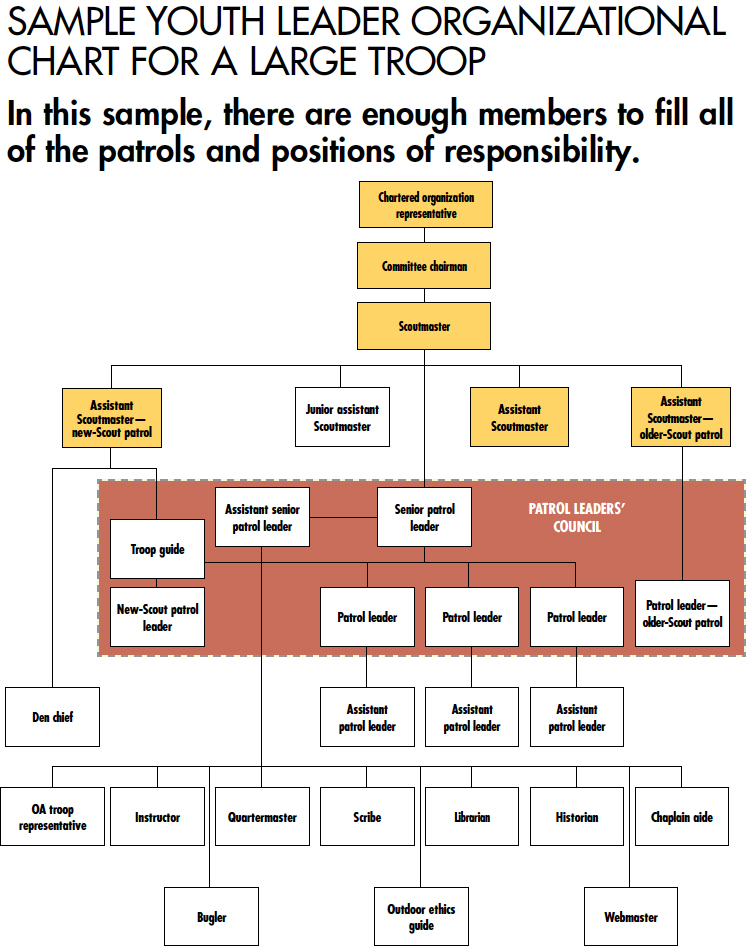 ## Adult Leadership [Section titled “Adult Leadership”](#adult-leadership) Adult leadership of the troop is organized this way: ### Scoutmaster Corps [Section titled “Scoutmaster Corps”](#scoutmaster-corps) The Scoutmaster, with their Assistant Scoutmasters, is responsible for providing direct training, coaching, and mentorship to all the scouts in the troop. They go to troop meetings and campouts, and model what it means to be a scout. The Scoutmaster is directly responsible for the scouts and their program. ### Troop Committee [Section titled “Troop Committee”](#troop-committee) The Troop Committee, led by the Committee Chair, oversees the Scoutmaster Corps and the troop’s “back of house” operations, such as treasury, fundraising, record-keeping, and other logistics.
# TroopWebHost
TroopWebHost is a software tool for scout troops, which 1607 uses to manage its calendar, emails, and money. Upon joining the troop, each scout and parent will get their own acount. [Troop Website](https://my.troop1607.org) [Get the Mobile App](https://www.troopwebhost.com/mobile.htm) todo
# Calendar and Signups
The troop calendar is kept on our TroopWebHost site. You can view the calendar, sign up for events, and subscribe to it with a calendar app such as Google Calendar or Outlook. [View Calendar](https://www.troopwebhost.org/FormList.aspx?Menu_Item_ID=45922\&Stack=1\&Application_ID=346) [Subscribe to Calendar](https://www.troopwebhost.org/FormDetail.aspx?Menu_Item_ID=45908\&Stack=1\&Application_ID=346) ## Event Pages [Section titled “Event Pages”](#event-pages) Each item on the calendar has a page with details about the event. Click on the event to view its page. ### Signups [Section titled “Signups”](#signups) You can yourself up for events from each event page. Scouts can sign themselves up from their own accounts, or parents can do it from theirs. Many events have a sign-up deadline, which is shown on the event page.
# Camping Equipment
## Patrol Gear [Section titled “Patrol Gear”](#patrol-gear) Each patrol has its own set of gear, which is administered by the Patrol Quartermaster. The gear is stored on the patrol’s shelf in the Quartermaster Room. Patrol gear includes things like tents, cooking equipment, water jugs, coolers, canopies, etc. ### Troop Gear [Section titled “Troop Gear”](#troop-gear) There is also troop-level gear, which is administered by the Troop Quartermaster. This includes things like backpacking gear, dutch ovens and other specialty cooking equipment, canoes, and much more. Scouts can talk to the Troop Quartermaster to sign out troop gear for their personal use. ## Personal Gear [Section titled “Personal Gear”](#personal-gear) There are a few pieces of kit that every prepared scout should have, which we call “personal gear”. It’s a good idea to permanently mark it with your name. Before each trip, check the forecast and pack accordingly. Troop camping trips will generally not be canceled on account of “bad” weather! Talk to your Patrol Leader if you have questions about personal gear. You can find lots more information about camping gear in your Scout Handbook. A note for parents Please don’t do the packing for your scout! In Scouting, participants learn by doing things for themselves and practicing independence. Instead of packing for your scout, give them this list and help them learn how to pack. If your scout has any questions, they should contact their Patrol Leader. A brand called Alps Mountaineering, which makes decent entry-level gear, offers special discounts to all scouts, scouters, and scout parents through their [Hiker Direct](https://hikerdirect.com/customer/account/create/) outlet. The site [ExpertVoice](https://www.expertvoice.com) offers deep discounts on a wide range of outdoor gear brands. Eagle Scouts, registered Scouting volunteers, and OA members are elligible. You have to upload the relevant proof of membership to get access. ### Sleeping bag [Section titled “Sleeping bag”](#sleeping-bag) Sleeping bags are rated for a certain temperature. Make sure your bag will be sufficiently warm for the trip you’re going on. Beware of the difference between “minimum/extreme” temperature ratings and “comfort” ratings. You can also combine two lesser sleeping bags to increase warmth. ### Sleeping pad [Section titled “Sleeping pad”](#sleeping-pad) These are for thermal insulation and ground padding. No matter how warm your sleeping bag is, you will need to supplement it with a sleeping pad on cold nights. The warmth of a sleeping pad is measured in R-value. 2 is enough for moderate weather. In winter weather you’ll want 3.5 or more. The R-value ratings add together when you stack multiple pads. ### Duffel bag [Section titled “Duffel bag”](#duffel-bag) You’ll need a duffel bag or some other container to carry your gear in the car/trailer. ### Appropriate footwear [Section titled “Appropriate footwear”](#appropriate-footwear) Your footwear should be matched to the activity. Always bring at least one pair of closed-toe shoes. Hiking shoes/boots are often good to have on trips. Multiple pairs of synthetic or wool socks are recommended. ### Appropriate clothing [Section titled “Appropriate clothing”](#appropriate-clothing) You’ll need to wear clothing matched to the conditions- we rarely cancel for bad weather! Consider bringing some extras in case you get wet. ### Snow boots and gloves [Section titled “Snow boots and gloves”](#snow-boots-and-gloves) These are sometimes necessary during winter trips. They should be warm and waterproof. ### Mess kit [Section titled “Mess kit”](#mess-kit) A bowl to eat out of, and a utensil to eat with. Metal or plastic. Optionally, a cup for hot drinks. ### Knife [Section titled “Knife”](#knife) You must earn your *Totin’ Chip* before carrying a knife at scouting events. It’s recommended to use a knife that locks in the open position or has a fixed blade. The use of folding knives with non-locking blades is discouraged because they’re less robust and can accidentally close on your fingers while in use. ### Reusable water bottle(s) [Section titled “Reusable water bottle(s)”](#reusable-water-bottles) Should hold at least 1 liter total. Nalgene bottles are a popular choice. ### Headlamp or flashlight [Section titled “Headlamp or flashlight”](#headlamp-or-flashlight) A headlamp is the suggested option for light, but a flashlight is also okay. ### Rain gear [Section titled “Rain gear”](#rain-gear) A scout is prepared for rain on every trip regardless of the forecast. Always have a rain jacket or poncho. Rain pants can also be good to have. ### Daypack [Section titled “Daypack”](#daypack) A simple backpack to carry things around camp or on a day hike. This could be your school backpack. ### Basic first aid kit [Section titled “Basic first aid kit”](#basic-first-aid-kit) A minimal personal first aid kit. Look in your scout handbook to learn about what you need. Tell the Scoutmaster if you need to bring personal medications.
# Being Grubmaster
The scouts in each patrol take turns being the one responsible for purchasing the food and consumable supplies for a campout. This scout, who gets selected by their Patrol Leader, is called a grubmaster. This is a very important job! Your patrol members are going to be hungry and unhappy if you don’t buy enough food and leftover food is often wasted if you buy too much. A Scout is Thrifty is an important Scout Law to remember. Knowing your budget, planning your meals, and managing your funds are a big part of being successful in this leadership task. Note that being a grubmaster is necessary to complete some of the requirements for your First Class rank! ## Menu Planning [Section titled “Menu Planning”](#menu-planning) Your Patrol Leader will lead the menu planning and provide you with a [Grubmaster Plan](https://docs.google.com/document/d/1uGScyv1R5mPCf8CKOCQVYXj9wj_y5sWUuX7sqaxsJco/edit) sheet. This sheet will contain a list of the food and supplies you need to buy, your budget, and your patrol leader’s phone number, among other things. Your patrol leader will sign at the bottom to officially approve it. You should bring this sheet when you go shopping and call your Patrol Leader beforehand if you have any questions. ## The Food Locker [Section titled “The Food Locker”](#the-food-locker) There is a food locker located in the Quartermaster Room. This locker has leftover non-perishable foods from previous trips, and grubmasters can take anything they need from it for free. Be sure to check the locker before you do your shopping. After the trip, your patrol will return any new leftovers to the locker. ## Money and Budget [Section titled “Money and Budget”](#money-and-budget) Caution You must show the Troop Treasurer your Grubmaster Plan, signed by your Patrol Leader, to get your budget paid out to you. The grubmaster budget for each campout is based on the number of scouts attending in the patrol. The standard budget is $20 per scout for a weekend campout. ## Packing the Food [Section titled “Packing the Food”](#packing-the-food) Your patrol has its own cooler and dry goods bin, located on your patrol’s shelf in the Quartermaster Room. Bring these home with you and pack the patrol food in them. The troop also has a supply of ice packs, which can be found in the basement freezer. At-home preparation may make your cooking at camp quicker and easier. For example, you can pre-chop vegetables and pre-cook some meats. Bring your dry goods bin to the Trailer Loadup, and the cooler to the meetup on the first night of the campout. ## The Parent’s Role [Section titled “The Parent’s Role”](#the-parents-role) Parental advice, input, and transportation are important to the Grubmaster’s success. However, the *scout* is the Grubmaster. They are expected to plan and purchase for the outing. This means that the Grubmaster goes to the store and makes the decisions, not just the parent(s). This is an opportunity for your scout to learn planning and shopping skills, and to develop leadership and responsibility by serving their patrol.
# Parent Camping Guidelines
Thank you for volunteering to help out on a Troop 1607 outing! Adult volunteers are essential to any successful troop camping event. While parents are always welcome at any event, there are some important things to understand before your first trip. This page was adapted, with permission, from the [Troop 33 Minneapolis Handbook](https://www.troop33.net/misc/parent_guidelines_for_camping_33.html). ## An Adult’s Role in Troop Camping [Section titled “An Adult’s Role in Troop Camping”](#an-adults-role-in-troop-camping) Scouting is a youth-led program. This means that all troop and patrol activities are planned, prepared, and run by the scouts, under the advisement of adult “scouters”. Scouting is designed to help scouts learn lifelong skills that include outdoor skills and practical skills like cooking, but more importantly, to learn and experience leadership and the many “soft skills” that come with it. An adult’s job on a campout is to ensure that the scouts have the opportunity to develop that leadership. This is not always an easy thing to do, in fact at times it is quite difficult. Some scouts take to leadership more readily than others. Often, when a patrol of younger scouts is working at building a campfire in wet weather, and having a few difficulties doing it, it is hard not to just step in and do it for them. Especially when the Scouts are cold, wet, hungry and grumpy (and your scout is one of them). Doing this may solve an immediate problem, but it does not help in the long run. It deprives the youth leaders an opportunity to both show and develop their leadership skills, and it undermines their leadership status with the other scouts. The right approach in a case like this would be to get one of the youth leaders and ask them to check in on that patrol and to help out if necessary. That youth leader will hopefully use their experience to teach the younger Scouts how to build the fire in wet conditions. The adult’s role on a campout is more of a supervisory role. Adults are there to provide the transportation to and from the event, to make sure that no one gets hurt, and to occasionally provide timely pointers to the youth leaders. The actual leadership and teaching during campouts is handled by the scouts, which is a core feature of the Scouting program. ## Adult Expectations on Outings [Section titled “Adult Expectations on Outings”](#adult-expectations-on-outings) ### Defer to the youth leaders. [Section titled “Defer to the youth leaders.”](#defer-to-the-youth-leaders) The youth leaders are responsible for the scouts in their patrol/troop. Patrol leaders are the primary leaders in Scouting, who should always be the first person turned to for questions and assistance. When a scout, even your own child, asks you a question such as “can you show me how to set up this stove”, “how many miles of hiking do we have left”, etc, you should always direct them to their Patrol Leader. Adults should only go around the youth chain of command when there’s an immediate risk of danger or damage. ### You’re here for all the scouts, not only your child. [Section titled “You’re here for all the scouts, not only your child.”](#youre-here-for-all-the-scouts-not-only-your-child) While you’re on a campout, you’re attending not as a parent but as a volunteer, and as such you are responsible for all of the scouts, not just your scout. Just as you expect other adults to be responsible for your child on a campout when you aren’t there, you have to be responsible for their child when you are there. ### Let your scout be with their friends. [Section titled “Let your scout be with their friends.”](#let-your-scout-be-with-their-friends) Many times parents want to share the camping experience with their scout on a troop event by sleeping together in a tent with them. While that is a great thought, national Scouts BSA rules don’t allow scouts to share a tent with any adult. This is their chance to bond with one another and to build life-long friendships. We would encourage families that want to camp together to definitely do so, just not at scouting events. Similarly, you should allow them to fully participate in activities like hikes, games, etc, with their peers by choosing to hang back with the rest of the troop adults during those activities. ### Try to avoid your scout’s camping area. [Section titled “Try to avoid your scout’s camping area.”](#try-to-avoid-your-scouts-camping-area) This is especially true on your first few campouts with the troop. Often, if a scout’s parent is in the immediate area, the scout will naturally defer to the parent. They may just expect the parent to do things for them like putting up tents, getting the fire going, getting the food cooked, washing the dishes, etc. One of the main goals of Scouting is for scouts to learn independence, and having the parent hovering in their campsite discourages that. Please give your scout, and all our scouts, the opportunity to challenge themselves and grow by letting them handle these things for themselves. If they need help, a youth leader will be there to help them. ### Pack separate bags. [Section titled “Pack separate bags.”](#pack-separate-bags) You have your bag, and your scout has theirs. Scouts shouldn’t be entering into the adults’ camping area to ask their parents questions like “Can I get my mess kit from your bag?”. All of their items should be in the bag they are responsible for. ### Troop rules apply, not home rules. [Section titled “Troop rules apply, not home rules.”](#troop-rules-apply-not-home-rules) Just as you expect people to comply with your rules when they are in your house, your Scout will be expected to comply with our troop rules, even if they differ from yours, when on a campout with us. If your Scout’s bedtime is 8:30pm, on a campout they will likely stay up later than that. If your scout’s bedtime is normally 1am on a Saturday night, they will likely be asked to quiet down and go to sleep long before that on a campout. Please support the Troop’s rules while you are camping with us, and leave matters of discipline to the appropriate leaders. ### Avoid disciplining your own scout. [Section titled “Avoid disciplining your own scout.”](#avoid-disciplining-your-own-scout) This is often a tough one for parents. Too often parents see their own scout doing something that other scouts are doing, and will only say something to him about it, neglecting to mention anything to the other scouts. This leads to the Scout wishing that their parent wouldn’t come on campouts. Parents sometimes are embarrassed that their scout is behaving in a way that they feel they shouldn’t be, even though the Scoutmasters are aware of it and don’t feel it is a problem. Please try to avoid singling your scout out for any special criticism while you are along. ### Participate in the troop’s activities. [Section titled “Participate in the troop’s activities.”](#participate-in-the-troops-activities) Parents should refrain from pulling their scouts out of troop/patrol activities to do other things, and must always inform the SPL and Scoutmaster if they need to leave the camping area. ### Be aware that things may not be as clean or comfortable as you’d expect at home. [Section titled “Be aware that things may not be as clean or comfortable as you’d expect at home.”](#be-aware-that-things-may-not-be-as-clean-or-comfortable-as-youd-expect-at-home) Scouts may not be washing their hands or brushing their teeth as often as you would like, and things will generally not be as clean or tidy as you would have them at home. Don’t single your child out especially while on the campouts because of this. Also expect that dishes will not be as clean as they are at home, and that the food cooked by the scouts may not be as healthy or well-prepared as a home-cooked meal made by an adult. Remember that cooking and cleaning are part of the learning process for the scouts, and that no camping activity will ever be as clean and comfortable as your home life.
# Invite your Friends
The best way for someone to discover Scouting is an invitation from a friend who’s already in it. Everyone in the troop can help- scouts and adults alike. New members keep the troop strong. More scouts means fuller patrols, more people to lead and learn from, and more of the trips and activities you want to do. Every scout who joins today is a future Patrol Leader, Senior Patrol Leader, or Eagle Scout. It’s also more fun for you! Scouting is better with your best friends along. If they join, they can be in your patrol- camping, cooking, and working on ranks right beside you. ## Invite Someone [Section titled “Invite Someone”](#invite-someone) 1. **Talk about it.** Tell your friends what you enjoy about Scouting and the troop. 2. **Invite them to something specific.** “Come to Scouts sometime” is easy to ignore. “Come on our hike this Saturday” isn’t. Pick an upcoming meeting or event that’s fun and low-commitment. 3. **Make sure their parents know the details.** Who, what, when, where, and what to bring. Parents need this before they’ll say yes. 4. **Record it.** Let the Membership Coordinator know using the [recruiting lead form](https://forms.gle/Ry7THCLKod7Fwgw58), so they can follow up and help. 5. **Be their buddy.** Greet your friend when they arrive and stick with them so they’re not on their own. 6. **Help them sign up.** If they had a good time, point them to [Becoming a Scout](/basics/joining). [Invite a Friend to Do Something Fun (Scouting Magazine)](https://onscouting.org/2026/08/21/invite-a-friend-to-do-something-fun-it-could-lead-to-scouting/) ## The Recruiter Strip [Section titled “The Recruiter Strip”](#the-recruiter-strip) 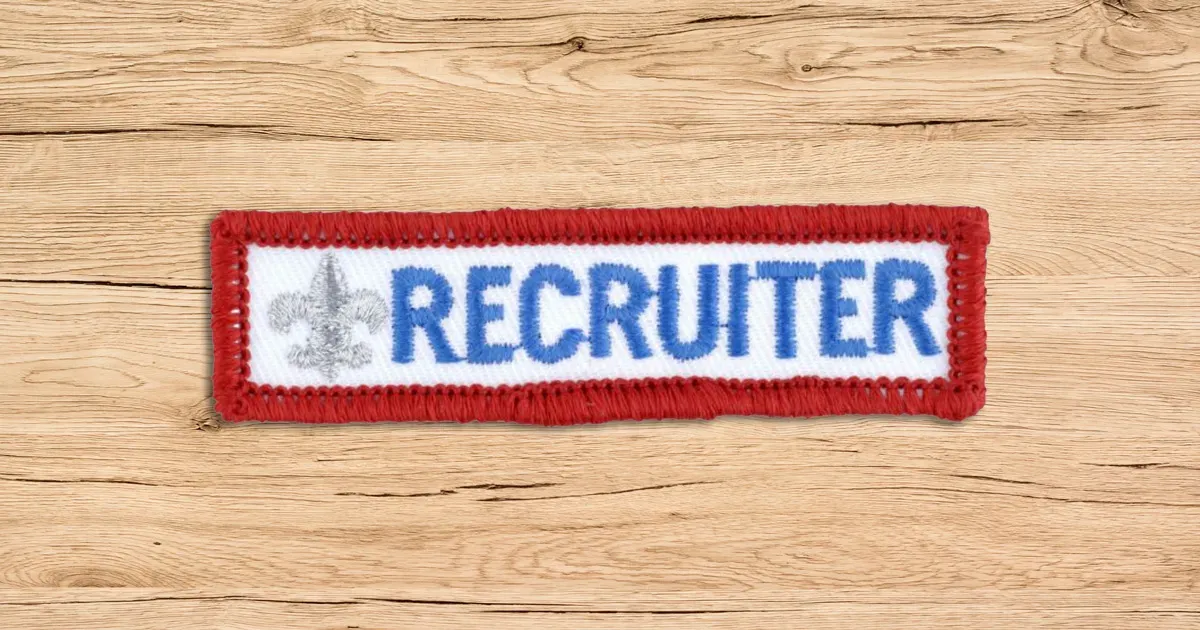 When a scout makes the primary contribution toward inviting someone who ends up joining the troop, they earn the Recruiter Strip. It’s worn below the right pocket on the uniform shirt. It’s a rare award, **and it’s often been called the single most important patch in all of Scouting**. Ranks and merit badges show what you’ve done for yourself, but the Recruiter Strip shows you’ve given someone else the chance to experience Scouting too.
# Positions of Responsibility
Positions of Responsibility, commonly called “leadership positions” or just “positions”, are jobs within the troop that are held by scouts. See [Troop Structure](/basics/structure) for an introduction. ## Obtaining a Position [Section titled “Obtaining a Position”](#obtaining-a-position) The exact way you obtain the position (by election or appointment) depends on which position. Terms are typically for one year. ***Before you try to obtain a position, make sure you’ve read and understood the responsibilities you’ll be taking on!*** You can find a full description of each position below. It’s highly recommended that you request an extra Scoutmaster Conference when you’re considering a bid for a position, so that you can discuss it with the Scoutmaster first and learn more about it. ## Position Manuals [Section titled “Position Manuals”](#position-manuals) Click on a position to open its reference manual. [Senior Patrol Leader](/appendix/youth-positions/senior-patrol-leader) [With three green bars behind the Scout emblem, the senior patrol leader's shoulder patch symbolizes one of the oldest leadership positions in Scouting. Scouting America has long recognized the senior patrol leader as the highest youth leadership position in a troop. They are the primary link between a troop's Scouts and its adult leaders. They shoulder the responsibility for leading meetings of the troop and the patrol leaders' council and provide valuable leadership in planning and carrying out the troop's program of outdoor activities, service projects, and events.](/appendix/youth-positions/senior-patrol-leader) [Assistant Senior Patrol Leader](/appendix/youth-positions/assistant-senior-patrol-leader) [The Assistant Senior Patrol Leader is the second highest youth leadership position in the troop, working closely with the Senior Patrol Leader to help the troop move forward. The ASPL acts as the SPL in the absence of the SPL or when called upon, and provides leadership to other youth leaders in the troop.](/appendix/youth-positions/assistant-senior-patrol-leader) [Patrol Leader](/appendix/youth-positions/patrol-leader) [The patrol leader is the patrol's key leader, representing the patrol at all patrol leaders' council meetings and the annual program planning conference, and keeping patrol members informed of decisions made. Patrol leaders carry out planning, leading, and evaluating patrol meetings and activities, and assure patrols are prepared to participate in all troop activities. They keep their patrol intact so they can work together and share responsibilities to get things done. It is incumbent upon them to be a good example for the members of their patrol and the rest of the troop.](/appendix/youth-positions/patrol-leader) [Troop Guide](/appendix/youth-positions/troop-guide) [Troop Guides serve as both a leader and a mentor to the members of the new-Scout patrol. They should be an older Scout who holds at least the First Class rank and can work well with younger Scouts.](/appendix/youth-positions/troop-guide) [Troop Scribe](/appendix/youth-positions/scribe) [The Scribe keeps the troop's records. They are the key scout that helps the Patrol Leaders' Council stay organized, work efficiently, and communicate well with the rest of the troop. Scribe is one of the most important positions for the success of a troop.](/appendix/youth-positions/scribe) [Troop Quartermaster](/appendix/youth-positions/quartermaster) [The Troop Quartermaster serves as the troop's supply boss. The Quartermaster's Room is their domain; they're given the "keys to the castle" and are fully responsible for the tidiness and order of their storage areas. They see that the gear is in good condition. They work with patrol quartermasters and check equipment in and out to people. They report to the PLC on the status of equipment and supplies in need of purchasing, repair, or replacement.](/appendix/youth-positions/quartermaster) [Den Chief](/appendix/youth-positions/den-chief) [Den Chiefs are Scouts who assist a Cub Scout Den Leader. They help Cub Scouts advance through the Cub Scout ranks, and encourage them to join a troop when they graduate.](/appendix/youth-positions/den-chief) [Chaplain Aide](/appendix/youth-positions/chaplain-aide) [Chaplain aides assist the troop chaplain (usually an adult from the troop committee or the chartered organization) in serving the religious needs of the troop. They lead the troop in opening or closing prayer and mealtime blessings. Chaplain aides ensure that religious holidays are considered during the troop's program planning process and promotes the Scouting America's religious emblems program.](/appendix/youth-positions/chaplain-aide) [Historian](/appendix/youth-positions/historian) [The historian collects, assembles, preserves, and is responsible for troop photographs, news stories, trophies, flags, scrapbooks, awards, and other memorabilia, and makes materials available for Scouting activities, courts of honor, the media, and troop history projects.](/appendix/youth-positions/historian) [Librarian](/appendix/youth-positions/librarian) [Troop librarians oversee the care and use of troop books, pamphlets, magazines, and audiovisuals. They check out these materials to troop members and maintain records to ensure that everything is returned. They may also suggest the acquisition of new literature and report the need to repair or replace any current holdings. They know when to proactively offer certain books as helpful resources for others.](/appendix/youth-positions/librarian) If your position isn’t listed here, refer to the standard descriptions from Scouting America: ## Leadership Training [Section titled “Leadership Training”](#leadership-training) When you enter a new position, it’s not expected that you already know how to do it! Holding a position should be a challenging experience for you. Shortly after getting elected or appointed, you’ll attend your ILST course. ILST will give you a solid start on your leadership skills and knowledge, as well as the particulars of your position. National Youth Leadership Training (NYLT) is a more advanced, week-long boot camp that will get you fully trained up and prepared to hold a senior leadership role. Talk to the Training Coordinator if you’re interested in finding out more. As you start carrying out your responsibilities, you’ll have either a youth or adult coach supporting you, depending on the position.